Award assurance · Research note 01
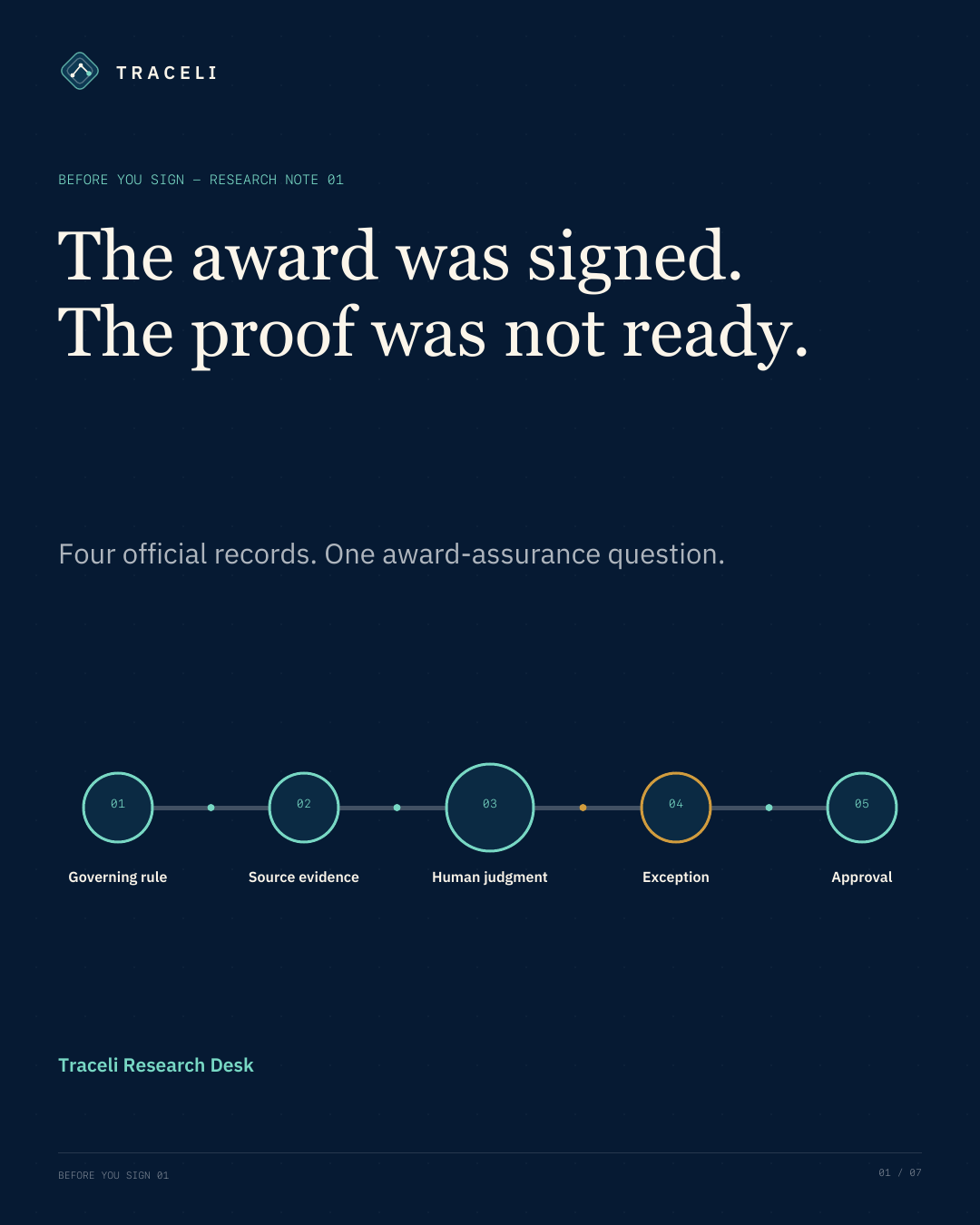
The award was signed. The proof was not ready.
Four official records show how procurement evidence gaps become audit, financial, funding and integrity problems.
Explore the visual briefingBefore You Sign · Visual briefing
The award record,
in seven frames.
Four official records. Seven questions for one completed award. Explore the briefing, then read the full analysis below.
Download the complete briefing7 pages · PDF · Sources included
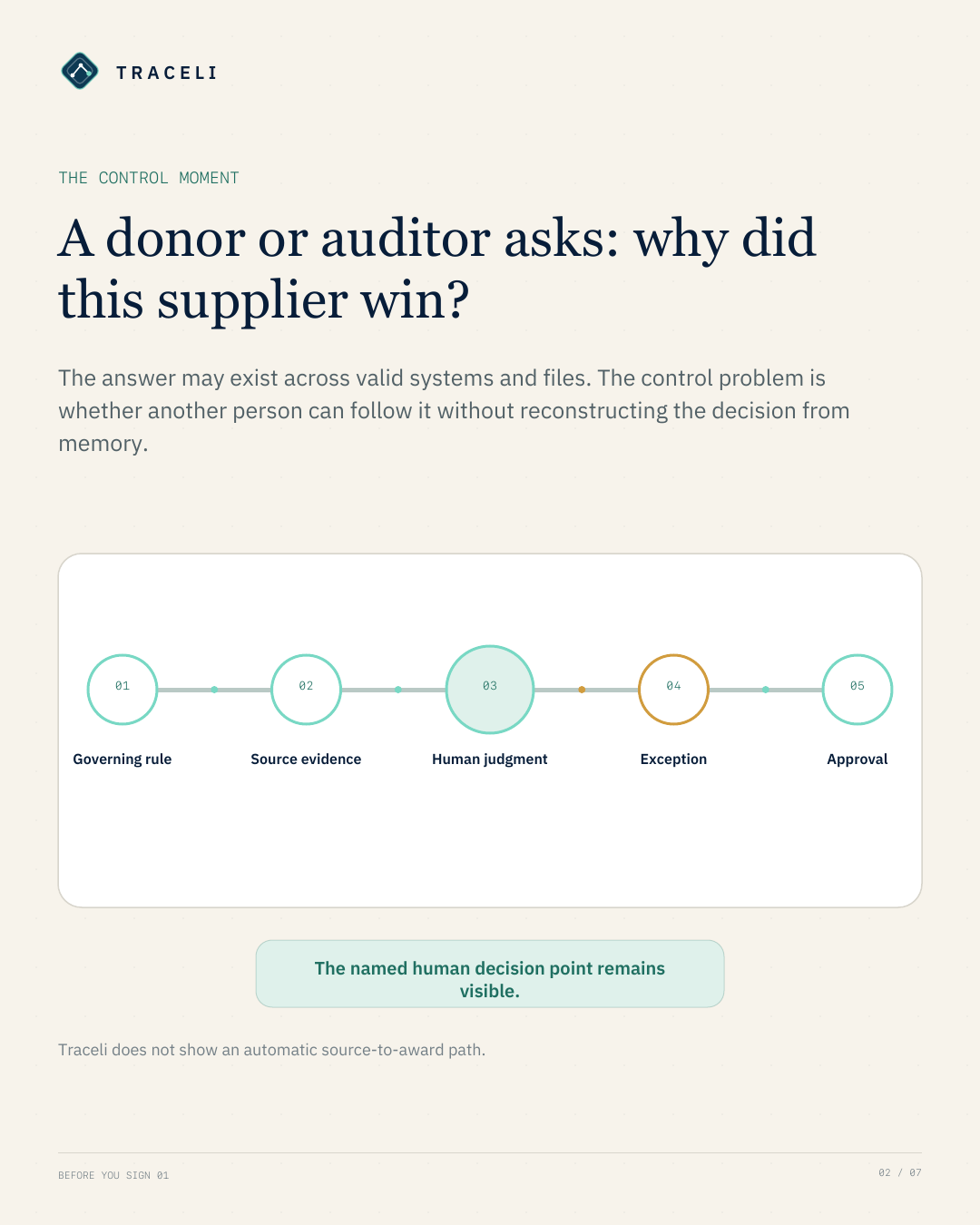
A donor or auditor asks a simple question: why did this supplier win?
The answer may exist. The governing rule is in one place. The bid evidence is in another. Evaluation notes sit in a file or an email. An exception was discussed in a meeting. The approval is visible in the enterprise system, while the reasoning behind it still depends on the people who were present.
The procedure may be complete. The payment commitment may be recorded. The accountable team may still need to reconstruct the record before it can explain the award from source to sign-off. This is the award proof gap.
The control problem begins at the point where a consequential decision has been made, yet the evidence behind it remains difficult to inspect as one record. A decision becomes more defensible when its rule, evidence, human judgment, exception and approval remain connected.
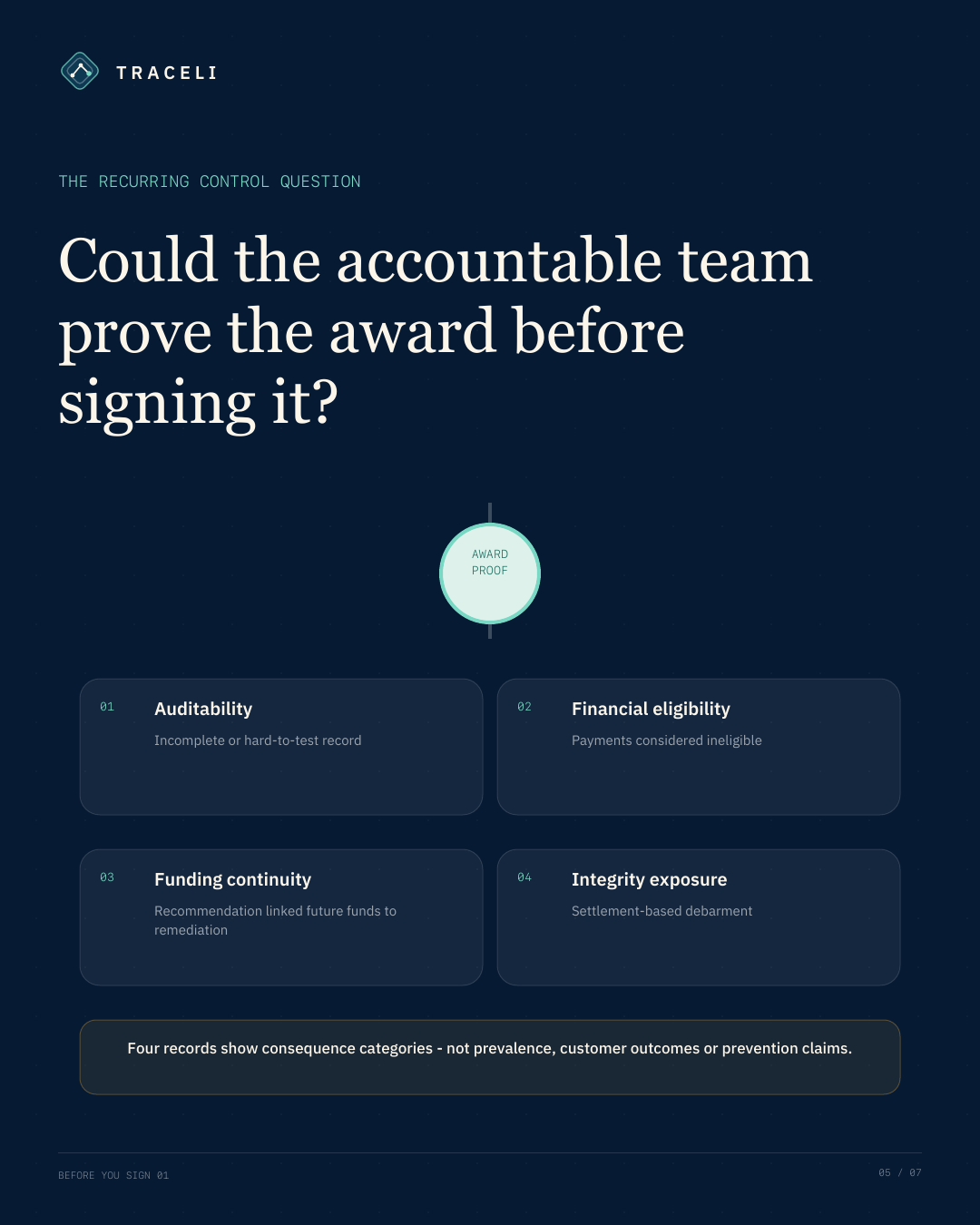
For donor-funded procurement, that connection matters before signature. Once the award moves forward, a weakness in its record can travel well beyond procurement. It can become an audit issue, an eligibility question, a condition on future funding or an integrity action.
Four official records show each of those consequence families. They do not establish how common the problem is. They show why the control deserves attention.
Consequence 01
Auditability
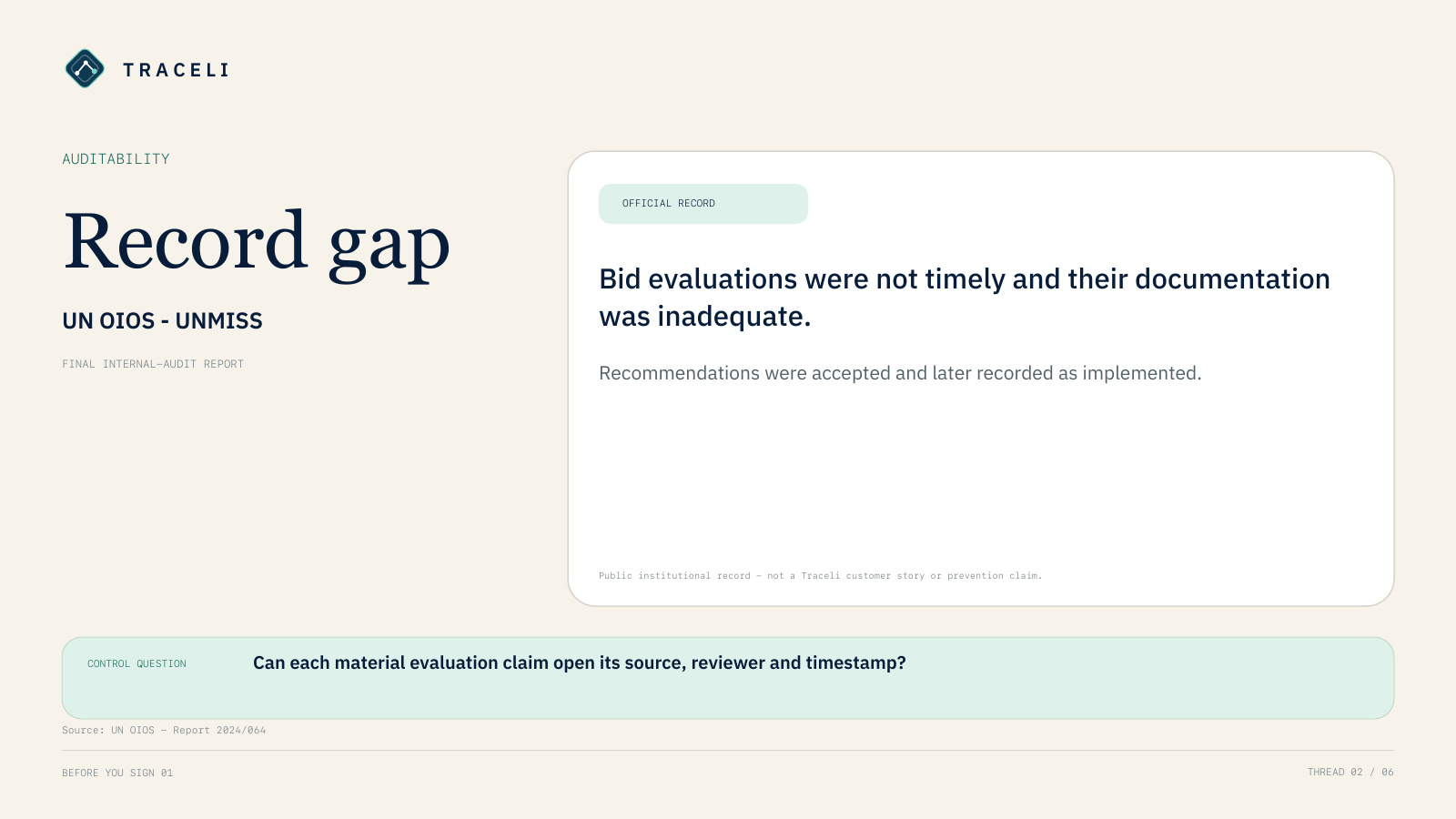
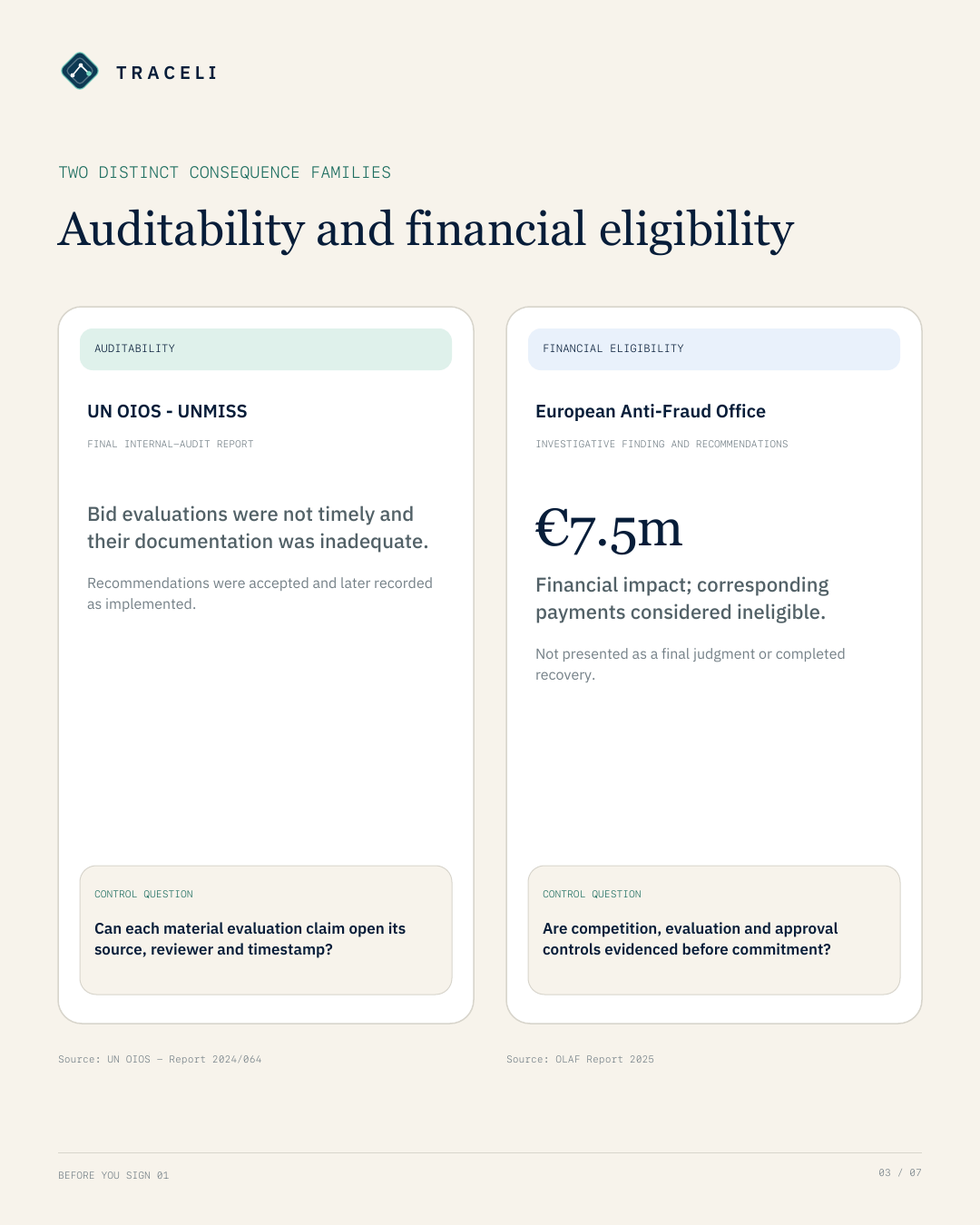
In a final internal-audit report on local procurement in the United Nations Mission in the Republic of South Sudan, UN OIOS found that bid evaluations were not timely and their documentation was inadequate. The recommendations were accepted by UNMISS, and OIOS later recorded both as implemented.
The practical question is direct. Can every material evaluation claim open its source evidence, reviewer and timestamp?
An approval record alone cannot answer that question. A defensible file needs the chain behind the approval. It should show the criterion that governed the evaluation, the evidence the reviewer considered, the judgment recorded against it, and when that judgment was made.
This is an auditability consequence. The official record is an audit report. It is not a fraud finding, a recovery or a sanction.
Consequence 02
Financial eligibility
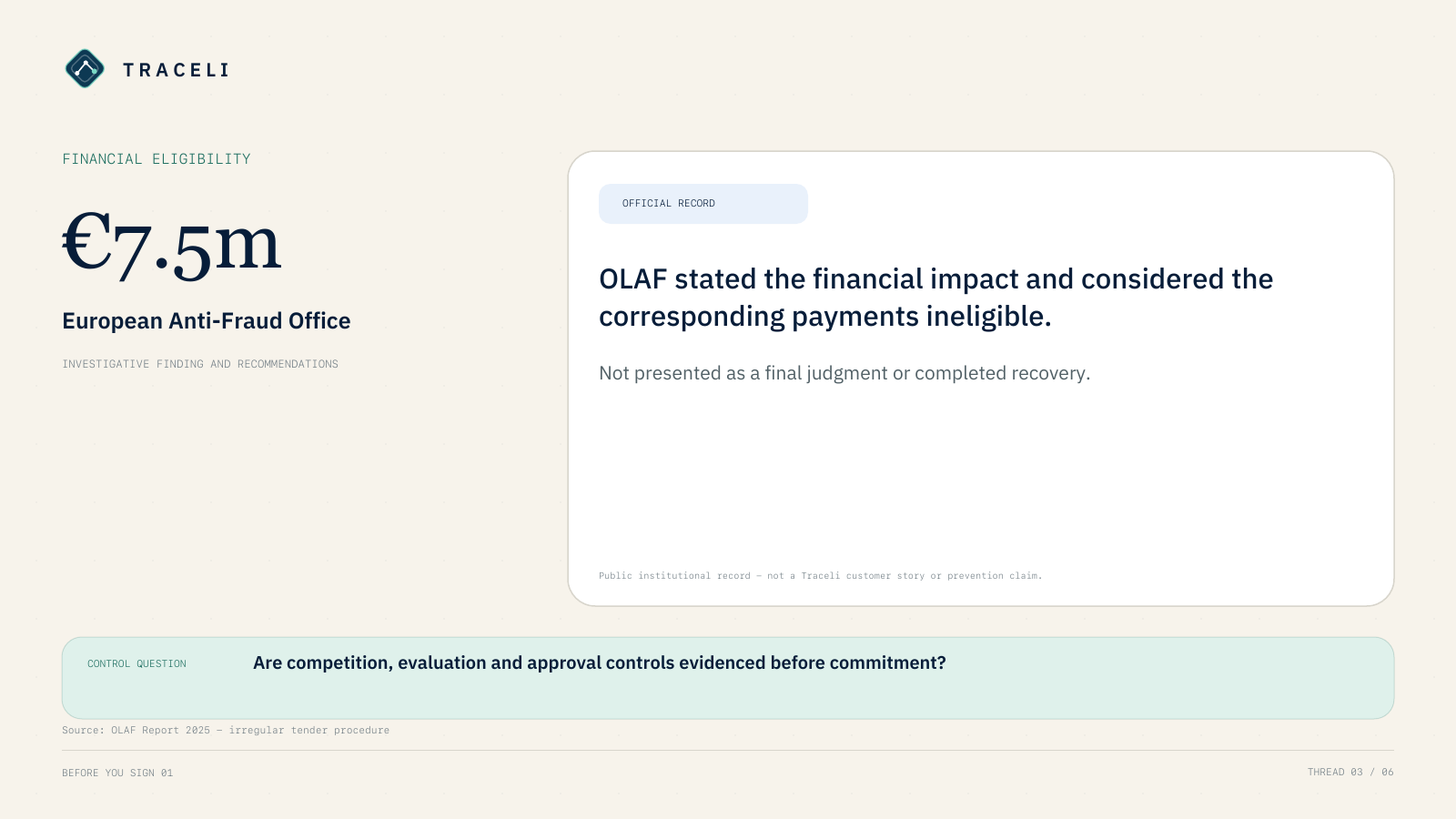
In its 2025 reporting, the European Anti-Fraud Office described an EU agency tender that it found irregular after failures in transparency, equal treatment and proper competition. OLAF stated that the financial impact was €7.5 million and that the corresponding payments were considered ineligible.
OLAF recorded an investigative finding and recommendations. That procedural label matters. The record supports a precise account of what OLAF found and recommended. It does not support replacing those words with a broader claim about a final judgment or recovery.
The control question is whether competition, evaluation and approval controls are evidenced before the commitment is posted. When that evidence is disconnected, the issue can leave the procurement process and reach the financial treatment of the resulting payments.
Consequence 03
Funding continuity
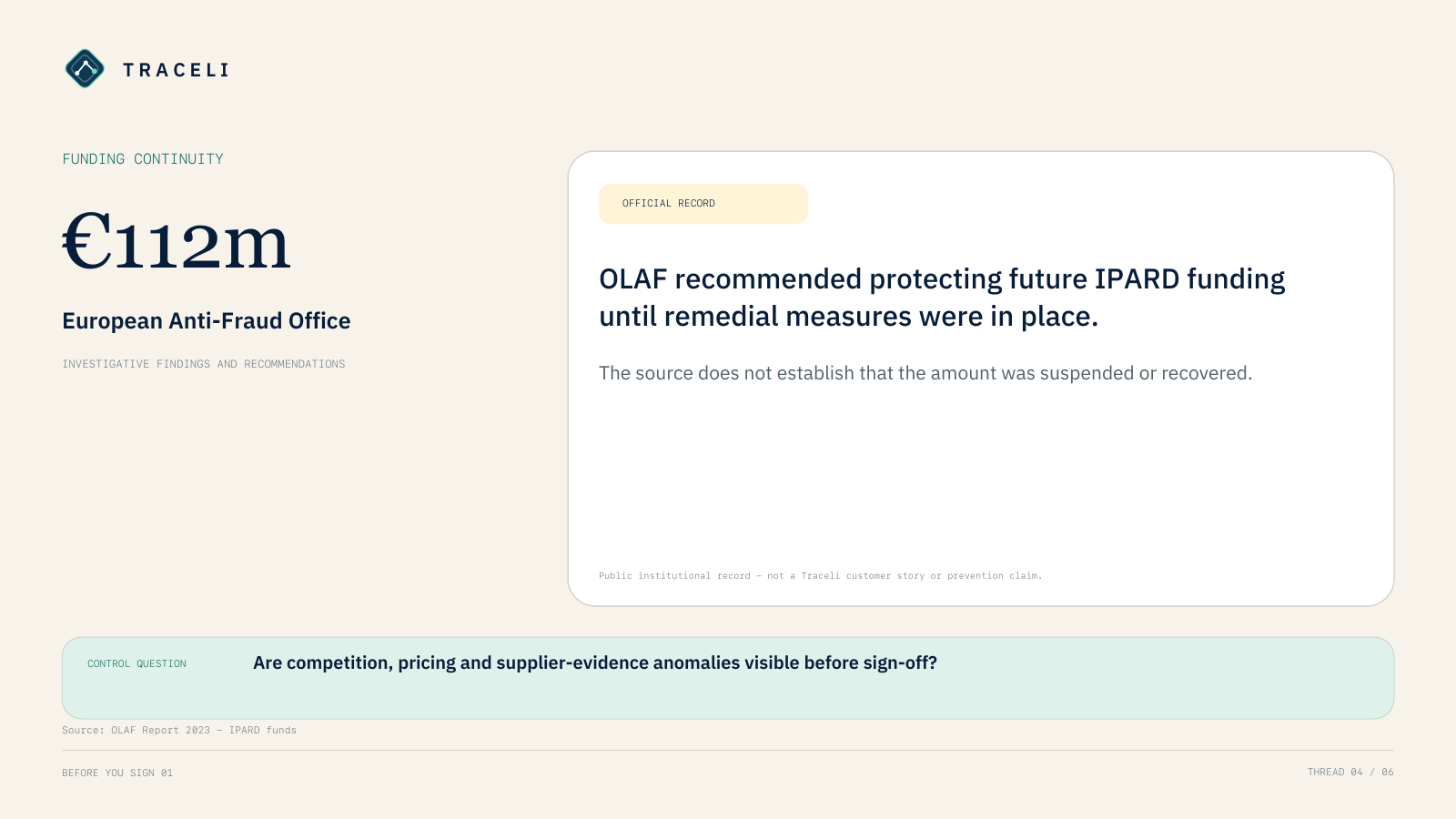
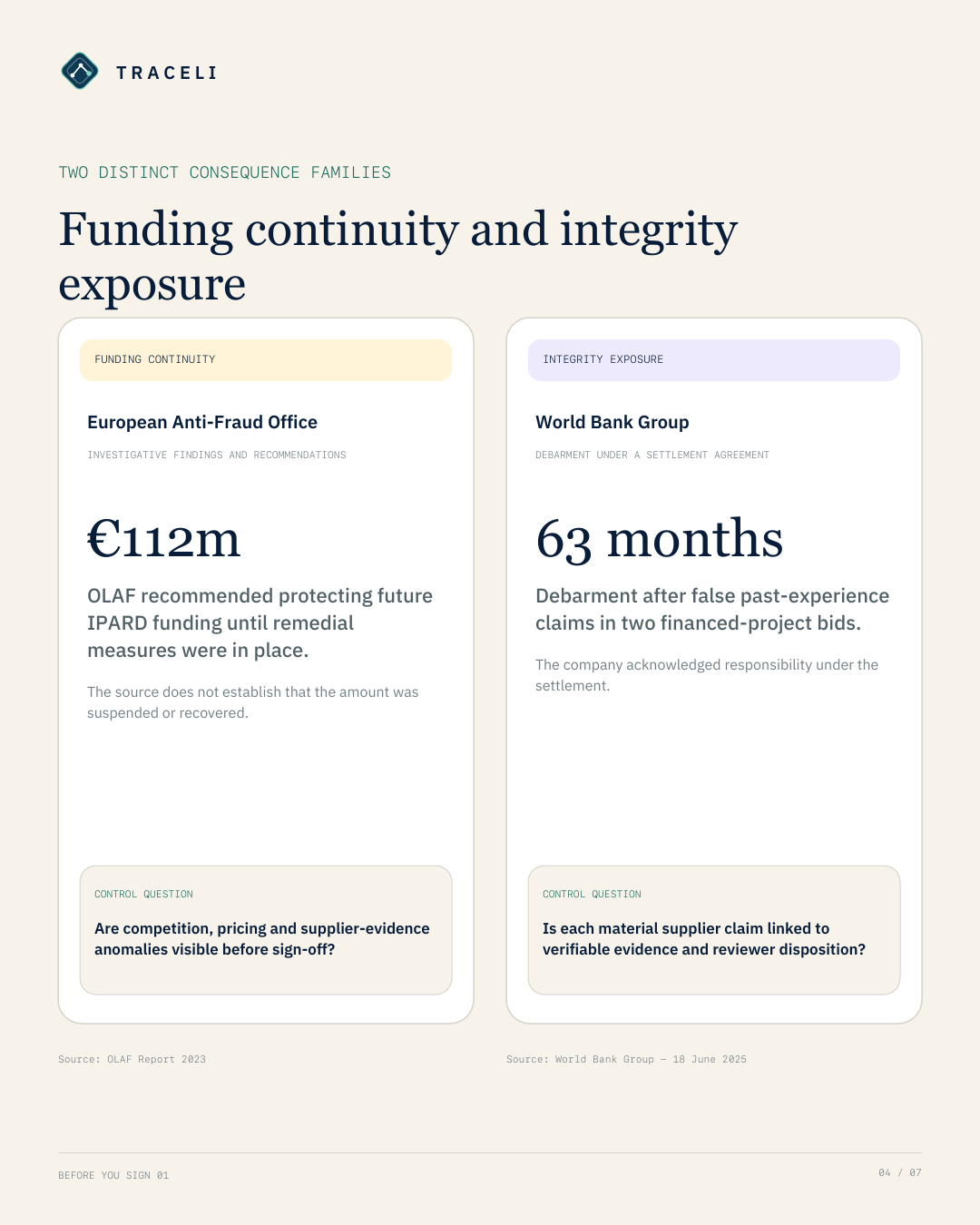
OLAF's 2023 reporting on pre-accession agricultural funding in Albania documented contracts awarded without competition or through rigged competition, fake offers and inflated prices. Following its investigation, OLAF recommended protecting €112 million of future IPARD funding until remedial measures were in place.
That amount must stay attached to its actual status. It was an OLAF recommendation concerning the protection of future funding. The official record reviewed for this article does not justify shortening the account to a claim that €112 million was suspended or recovered.
The award-assurance question is whether competition, pricing and supplier-evidence anomalies are visible to a named human before sign-off. The point is not to turn an investigator's record into a product claim. It is to see how an award-level control issue can become relevant to future funding decisions.
Consequence 04
Integrity exposure
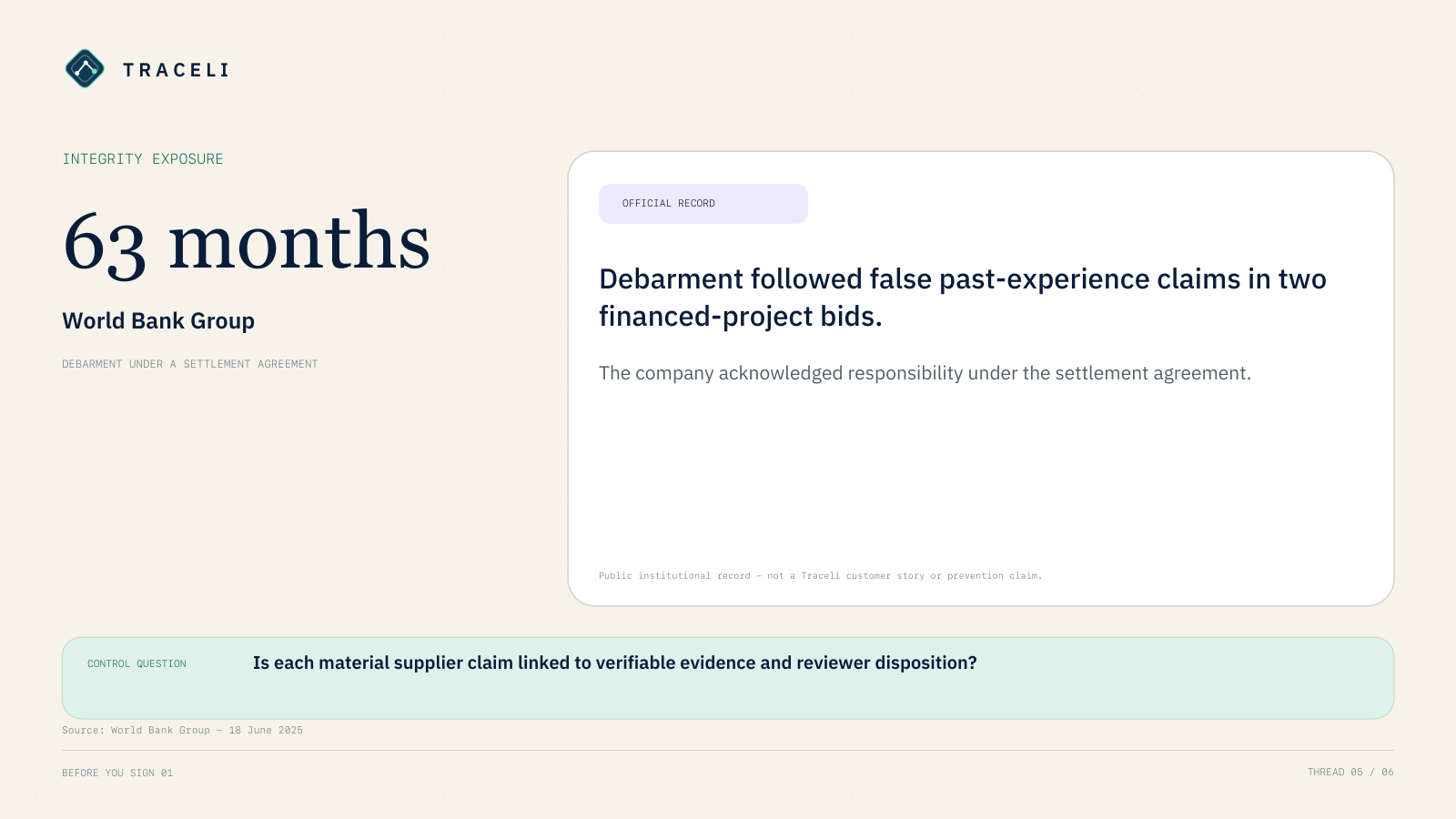
In June 2025, the World Bank Group announced a 63-month debarment of Pars Tableau Company under a settlement agreement. The company acknowledged responsibility after falsely claiming past experience in bids for two World Bank-financed projects.
This was a debarment, not an audit observation or an allegation. The relevant control question is whether every material supplier-experience claim is linked to verifiable bid evidence and an explicit reviewer disposition.
Verification is not only the presence of a document. The record should show what claim was tested, which source was inspected, who reviewed it, and whether the reviewer accepted it, rejected it or left it unresolved.
The award record
The recurring control question
These four records involve different institutions, procedures and consequences. They should not be collapsed into a single claim about procurement teams or donor-funded organizations. The useful common question is more disciplined:
Could the accountable team prove the award before signing it?
That means more than confirming that required fields are complete. A signatory should be able to see the governing rule, the supplier evidence, the evaluation judgment, any exception, its disposition and the final approval as a connected decision record.
Existing systems remain essential. The procurement portal manages the process. The ERP records the commitment. Document repositories preserve files. Email carries discussion. Each may hold a valid part of the answer. The gap appears when no governed record connects those parts well enough for an independent reviewer to test the decision without reconstructing it from scratch.
The award record
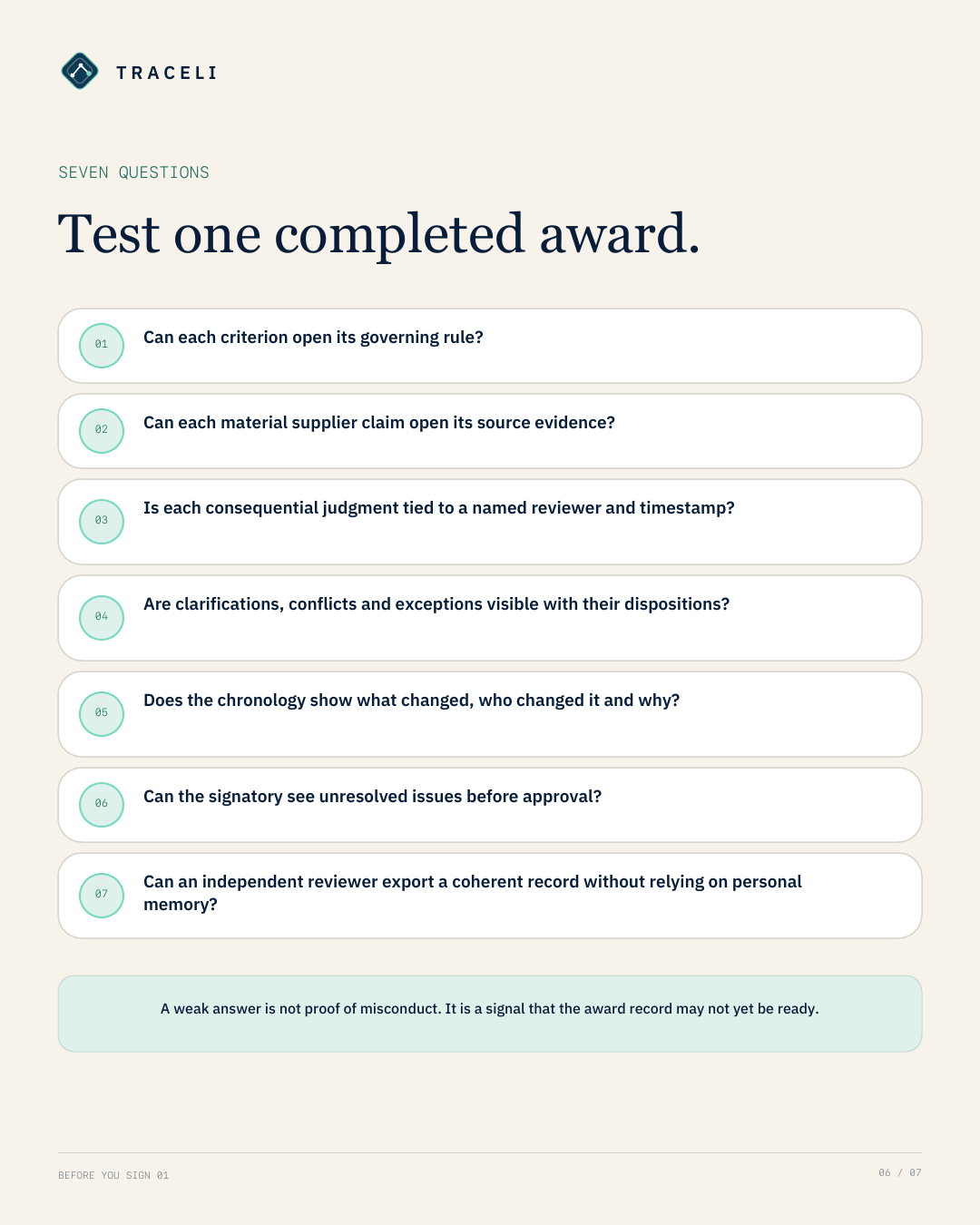
Seven questions for one completed award
Take one material award that has already finished and ask:
- Can each decisive criterion open the governing rule or approved evaluation method?
- Can each material supplier claim open the source evidence used to assess it?
- Is every consequential judgment tied to a named reviewer and timestamp?
- Are clarifications, conflicts and exceptions visible with their dispositions?
- Does the chronology show what changed, who changed it and why?
- Can the signatory see unresolved issues before approval?
- Can an independent reviewer export a coherent record without relying on personal memory?
A weak answer does not prove non-compliance, misconduct or financial loss. It identifies a proof gap that the accountable team can assess and resolve through its own governance.
The award record
Where Traceli fits
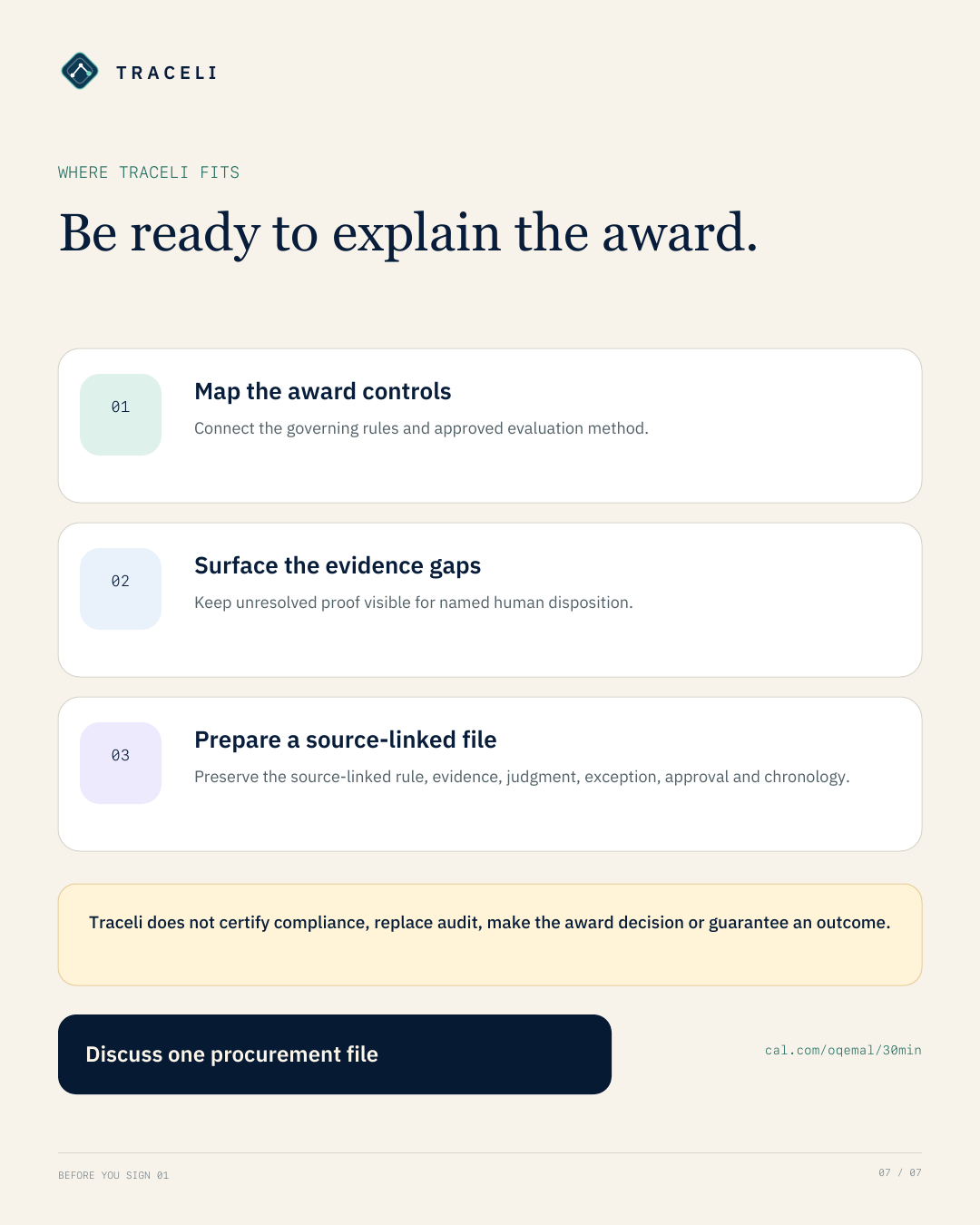
Traceli provides procurement evidence and audit-response support. A first engagement starts with one completed procurement file. We work with the accountable team to connect the governing requirements, supplier evidence, evaluation judgments, clarifications and approvals, then identify what remains unresolved for human review.
The scope depends on the file and the question the team needs to answer. Our existing six-week pilot is the starting commercial reference; any alternative duration or price would be agreed for a specific engagement. The deliverable supports the organization's own review. Traceli does not certify compliance, replace audit, guarantee an outcome or make the award decision.
An audit or assurance review approaching? Tell us what needs to be explained, to whom, and by when.
Methods and sources
Official records, read for control consequences.
This note uses public records from their issuing institutions. It summarizes the stated findings and outcomes, then identifies the award-assurance question they raise. It does not make an independent finding about the underlying parties.
UN Office of Internal Oversight Services
UNMISS local procurement: audit report 2024/064
Final internal-audit report. Recommendations accepted by UNMISS and later recorded as implemented.
Open official sourceUN Office of Internal Oversight Services
Recommendation implementation table, July 2026
Page 7 records both important recommendations for report 2024/064 as implemented: 2 of 2.
Open official sourceEuropean Anti-Fraud Office
OLAF Report 2025: an irregular tender procedure
OLAF reported a €7.5 million financial impact and considered the corresponding payments ineligible.
Open official sourceEuropean Anti-Fraud Office
OLAF Report 2023: serious misuse of EU pre-accession agricultural funds
OLAF recommended protecting €112 million in future IPARD funding until remedial measures were in place.
Open official sourceWorld Bank Group
World Bank Group debars Pars Tableau Company JSC
The settlement followed false claims of past experience in bids for two World Bank-financed projects.
Open official source