01 The cost of not being able to explain the award
People do not buy procurement software. They buy relief from the fear of not being able to explain the award — the reconstruction meeting where someone asks for the competition trail, the labour-cost basis, the reception minutes, the prequalification strip that was supposed to be there. The brochure for a tool is cheap. The finished, citeable record before you sign is the expensive thing. These four public Global Fund OIG files show why that distinction matters.
The blunt frame still holds: a ten-thousand-dollar tool that leaves you alone with the fear is not the same product as finished work that lets you walk into the meeting with the trail already frozen. This pack is not a feature tour. It is a research reading of four primary OIG reports — two audits/investigations on country grants, two supplier-side investigations — and a map of how Trace-li’s IP is shaped for the gaps those reports make visible.
02 Method & claim hygiene
pdftotext, and retained only figures that appear in those reports with page/section
locators in the sources appendix. Charts and case prose were rebuilt against that table — no invented numbers.
What we did not claim. That these are Trace-li clients. That Trace-li would have prevented the outcomes or rewritten history. That incomplete files equal diversion. That recommended recoverable amounts were recovered. That Agreed Management Actions are finished. That an OIG investigation is a criminal verdict. That Global Fund non-objection is a clean bill of health. That RDT findings imply efficacy failure or patient harm.
Cases locked after verification: Togo GF-OIG-25-005 (audit, 4 Jun 2025, §4.4 non-health procurement); Ghana GF-OIG-26-008 (investigation, 15 Jun 2026, services-contract labour costs); Zambia GF-OIG-23-022 (investigation, 20 Dec 2023, granular chlorine collusion); RDT sales GF-OIG-26-006 (investigation, 9 Jun 2026, fraudulent practices in HIV/malaria RDT sales). Togo is distinct from GF-OIG-26-004 — never merge those files. GF-OIG-26-013 (indirect procurement) and Cameroon GF-OIG-24-014 were screened and dropped as weaker award-file fits.
03 The pattern across four files
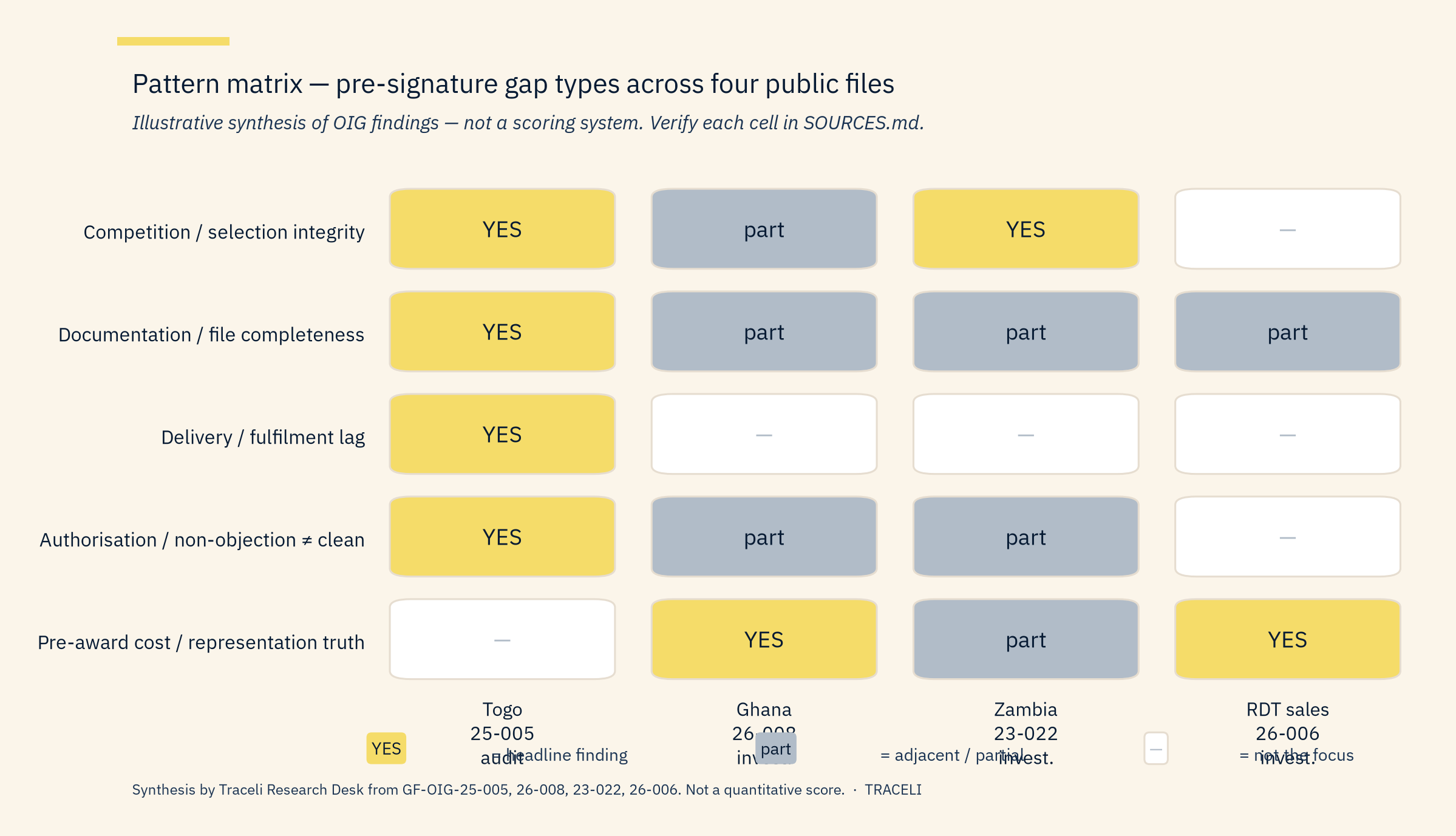
Different countries, different modalities, one recurring structure: competition integrity, file completeness, delivery/fulfilment, authorisation theatre, and pre-award cost or product representation. Not every file carries every gap as a headline. The matrix below is a synthesis — labelled as such — not a score.
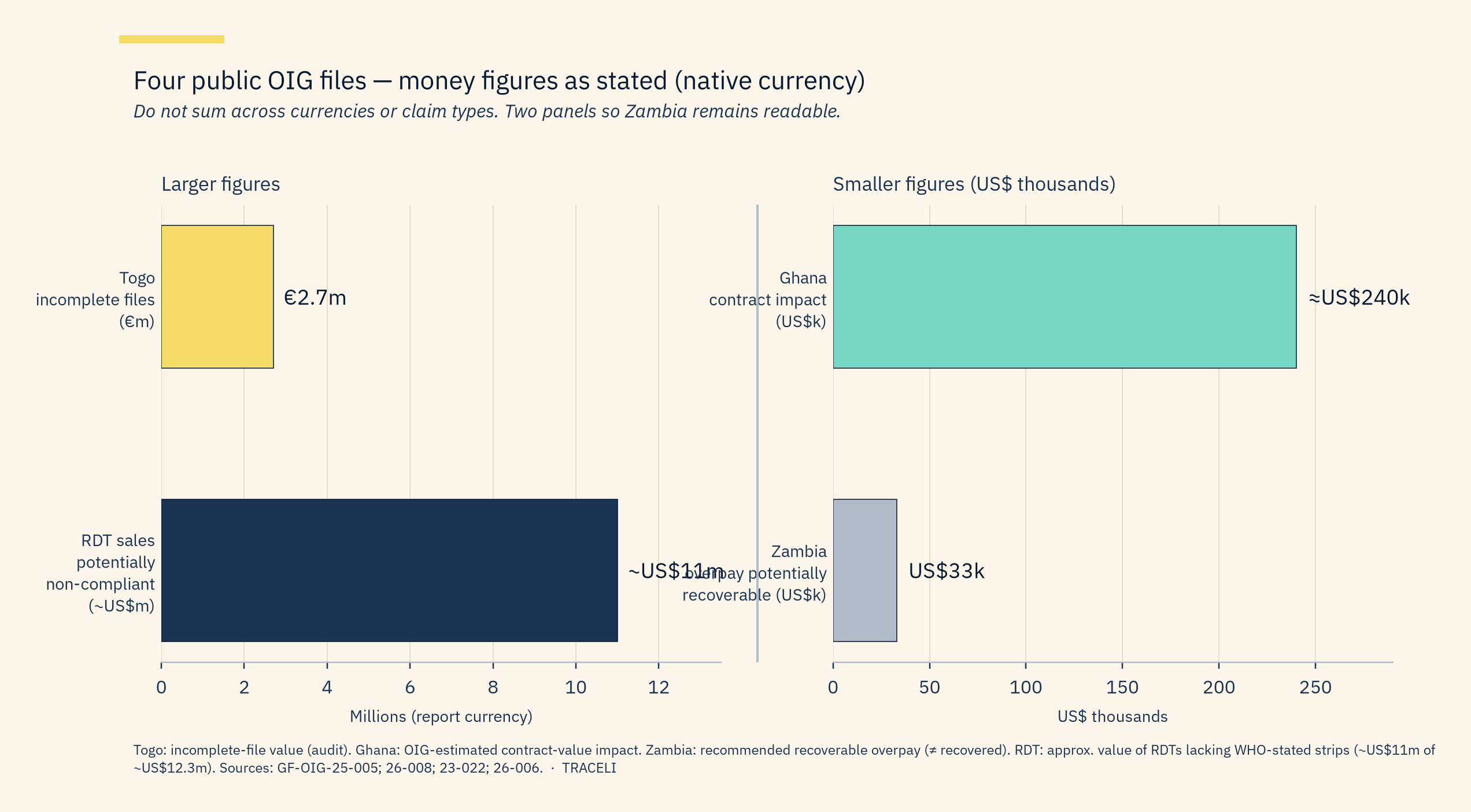
Money figures should not be stacked into a false total. Togo’s €2.7m is an incomplete-file value in an audit sample. Ghana’s ≈US$240k is an OIG-estimated impact on contract value. Zambia’s US$33k is recommended recoverable overpay on a US$78k contract. The RDT file’s ~US$11m is the approximate value of tests that could not have contained WHO-stated strips. Two panels keep Zambia visible without a messy log scale.
04 Value chain: how Trace-li’s IP is shaped for these gaps
We are not going to say Trace-li would have prevented these outcomes. That sentence is marketing cosplay. The useful sentence is narrower: this is what must be visible and dispositioned before signature — mapping the controls that should appear in the file, surfacing gaps while there is still time to refuse or remediate, and freezing a citeable record so the reconstruction meeting is boring.
Trace-li’s assurance path runs five stages. The diagram maps which OIG gap types hit which stage. The wireframes that follow are illustrative product UI from Trace-li’s award desk and rule library — not OIG exhibits, not client work.
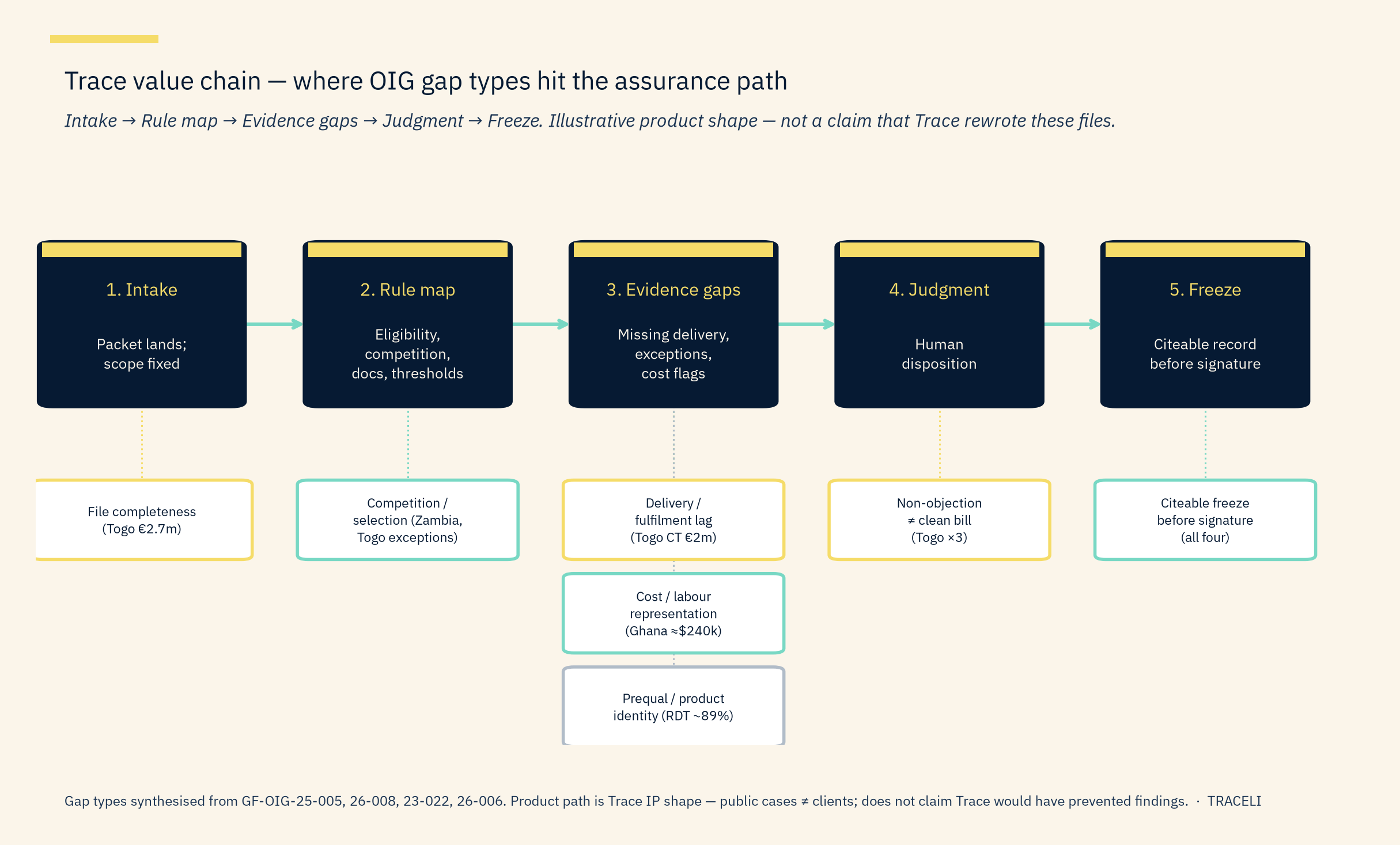
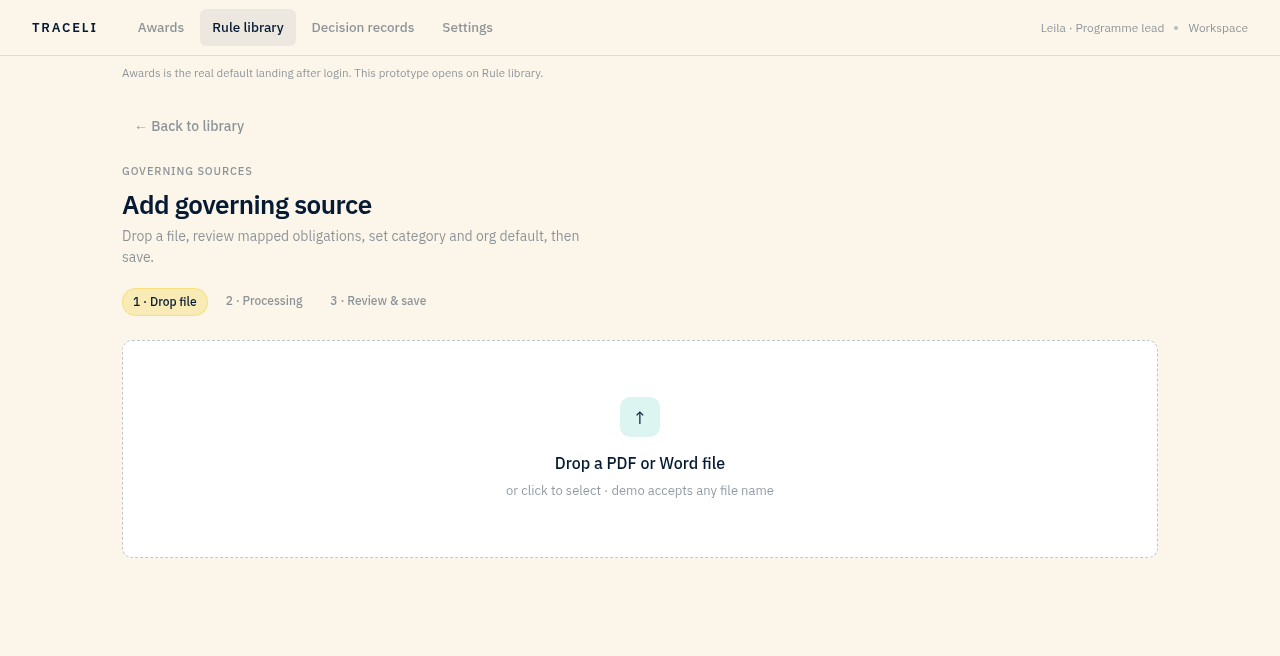
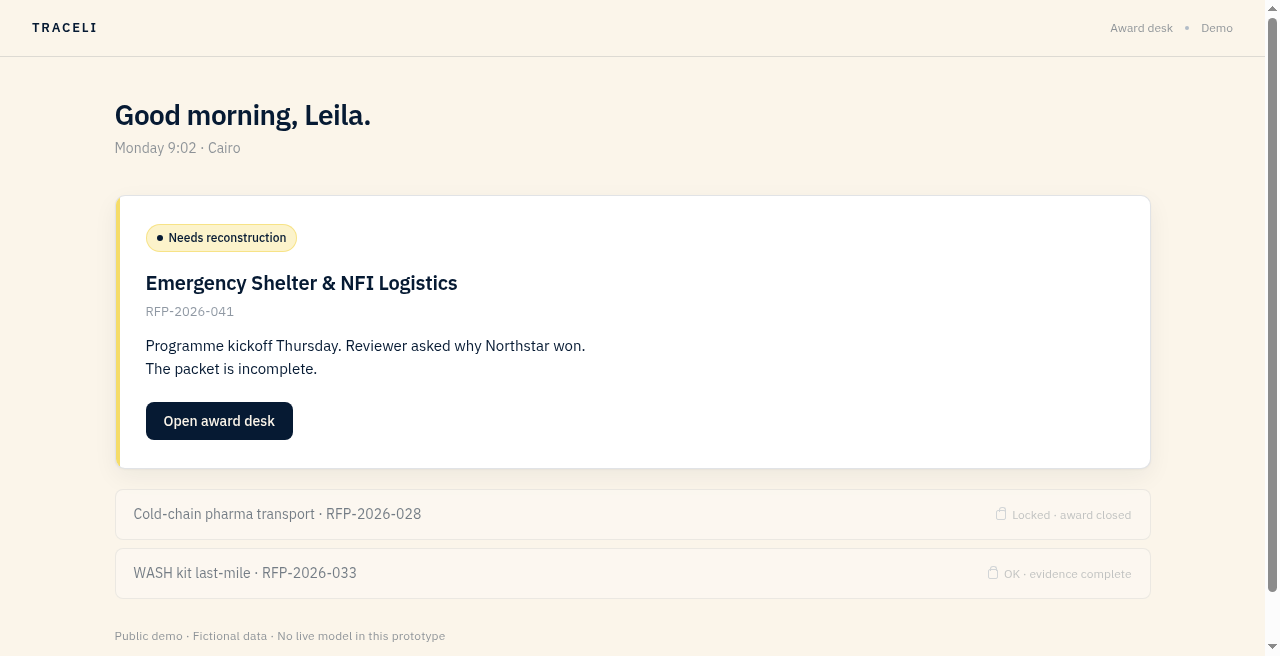
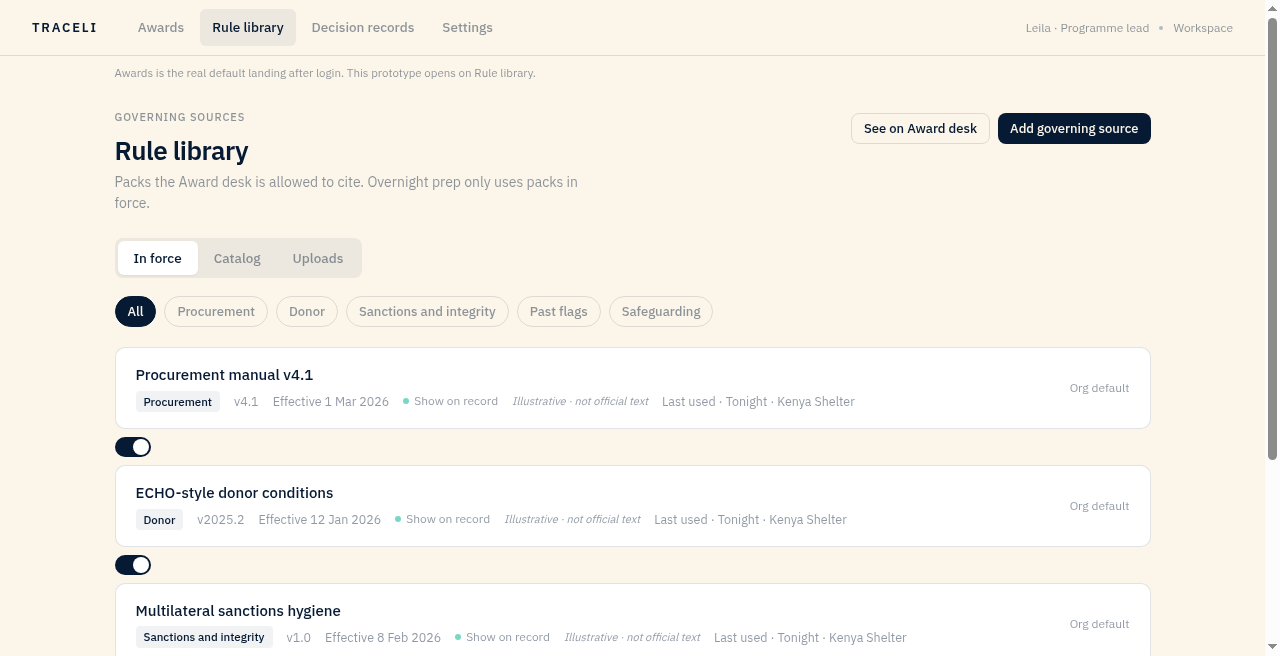
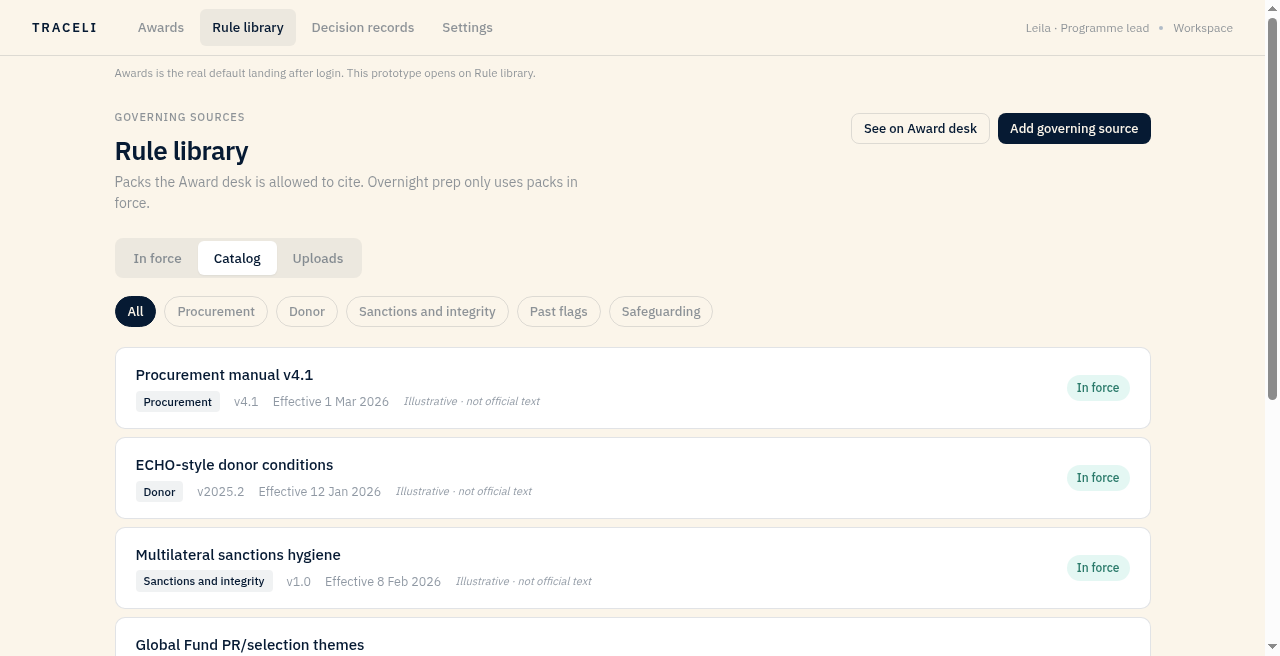
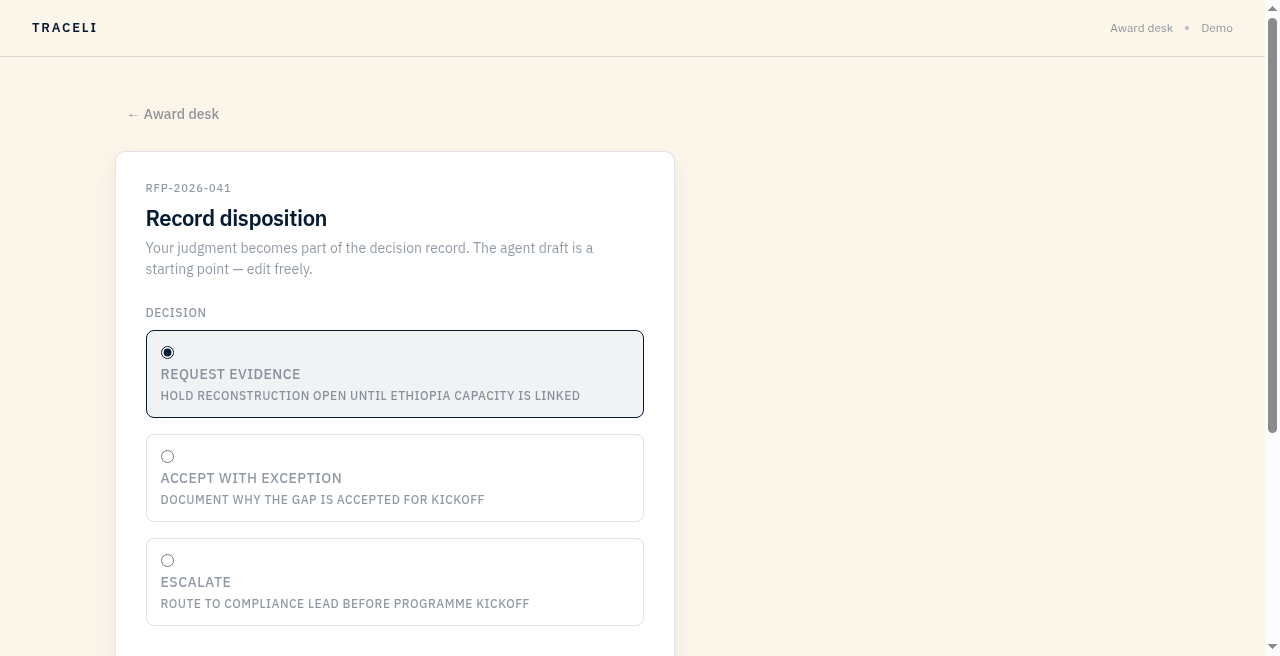
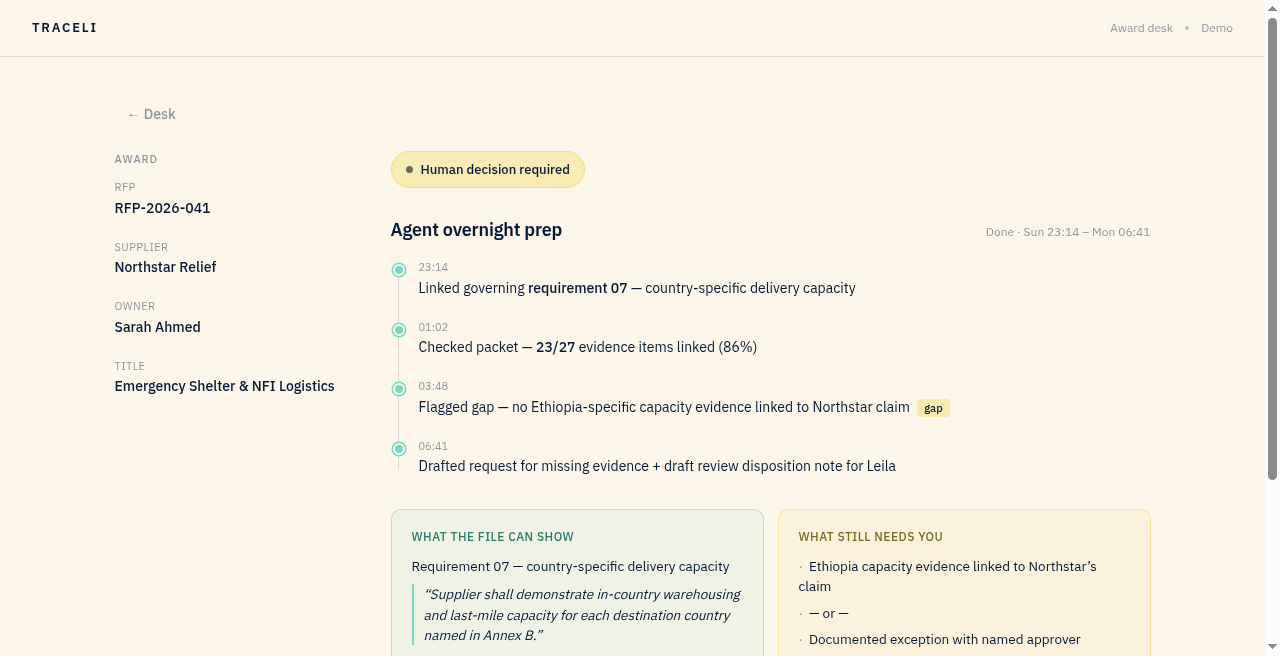
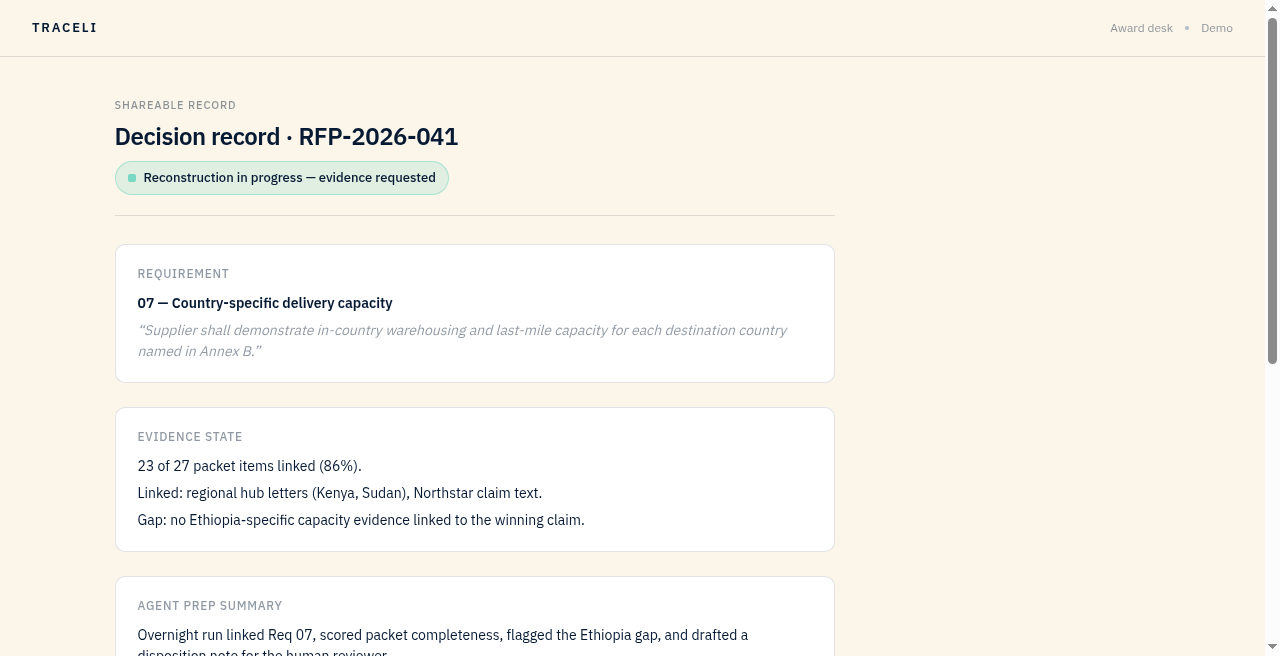
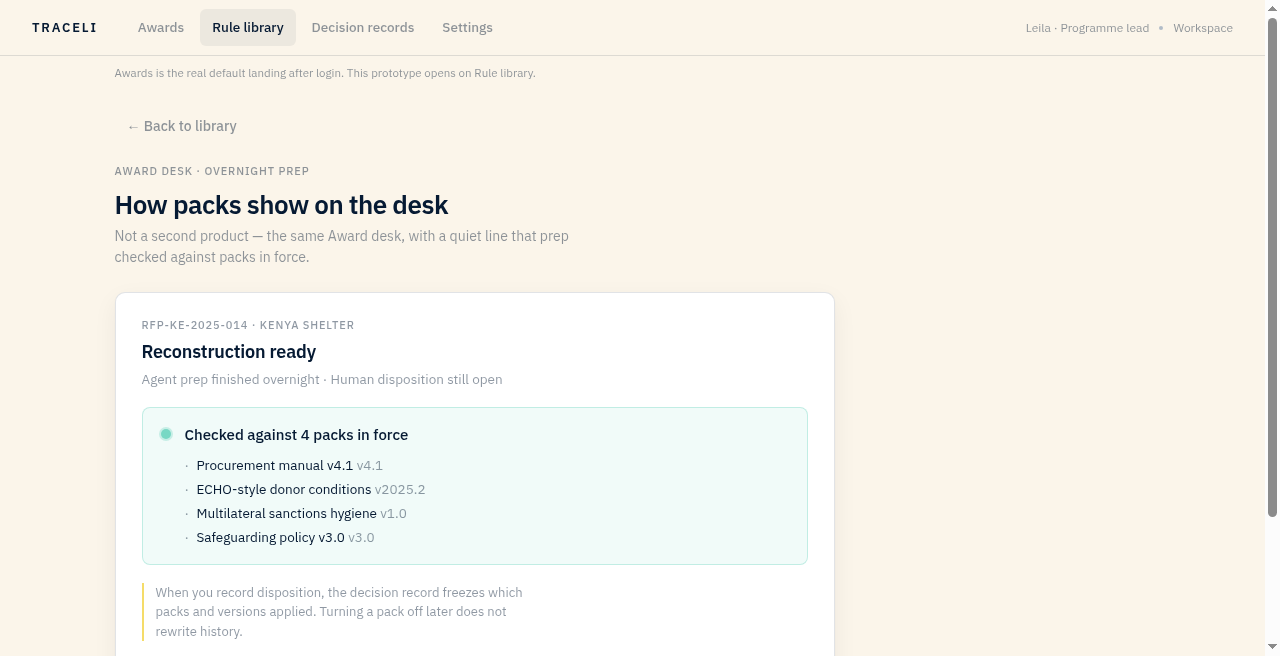
Shape, not feature laundry: map controls → surface gaps → freeze record. That is the product thesis for an AI-native assurance service — finished work, not an unfinished software promise. The four cases below each carry a product panel that names the verified OIG gap, shows a matching wireframe, and states what would be visible and dispositioned before signature. Explicitly: illustrative product UI; public case ≠ client; does not claim Trace-li would have rewritten history or prevented the finding.
05 Case 1 — Togo: when non-health spend outruns the file
Health products — about 49% of GC6 grant funds in the finding’s framing — run through the Global Fund pooled procurement mechanism. Non-health procurement, executed by the PR, is where oversight strained as volumes rose. Non-health procurements tripled from €2.4 million in GC5 to €7.9 million in GC6 (excluding C19RM-related). In GC6, an additional estimated €29 million was budgeted on non-health from C19RM. GC7 is projected at about €5.4 million (~5% of grants’ budget).
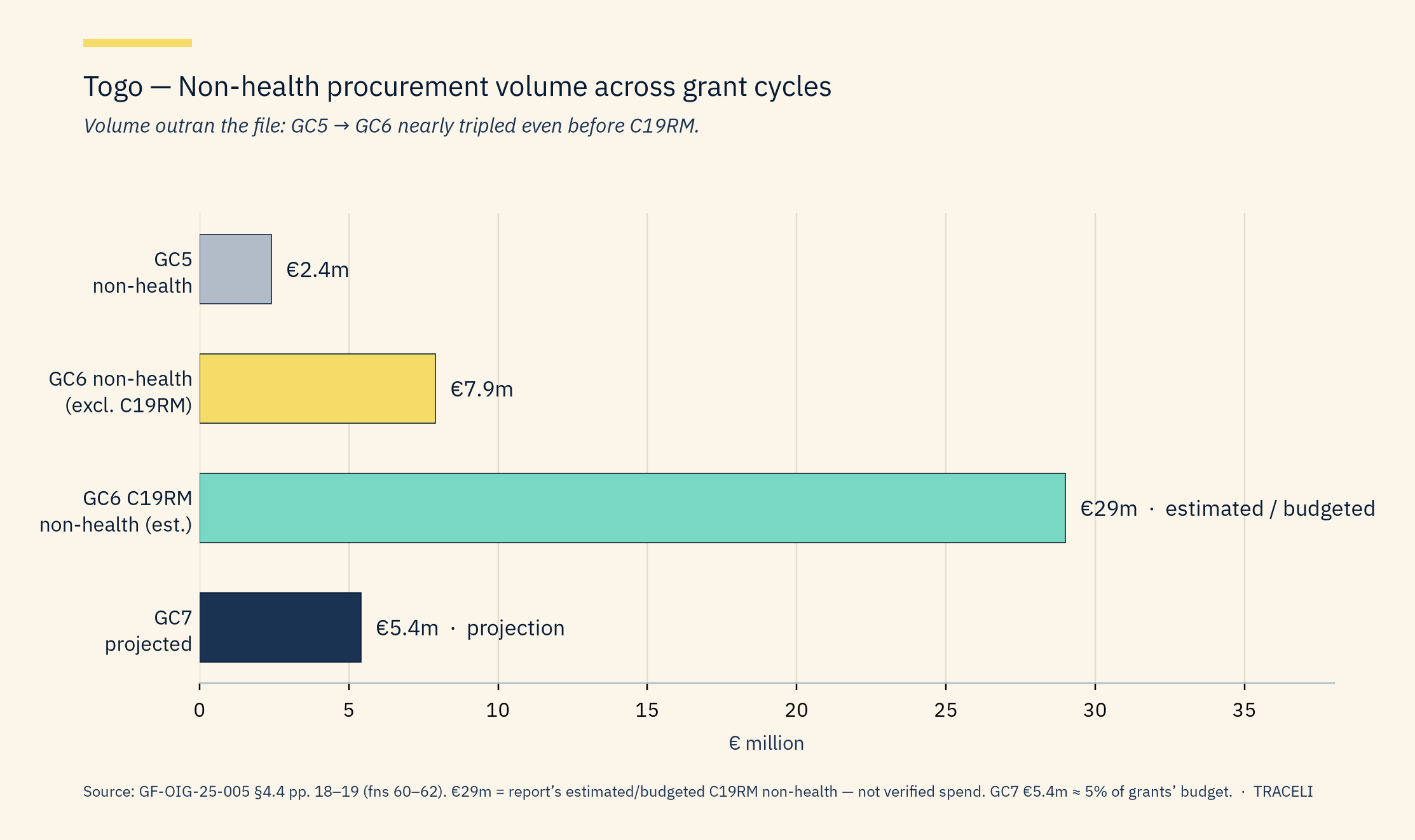
OIG reviewed 30 contracts representing 64% of total non-health products’ procurement value, 2021–2023. Delays appeared at process and signature stages. Programmatic knock-ons were concrete: smartphones for community DHIS2, planned for 2021, finalised only in September 2023; devices for LLIN campaign digitisation finalised after the campaign started.
The emblematic unfinished buy: a €2 million 2023 CT scanner contract with a four-month execution deadline — still unfulfilled as of October 2024, equipment at the supplier, manufacturer’s guarantee running out.
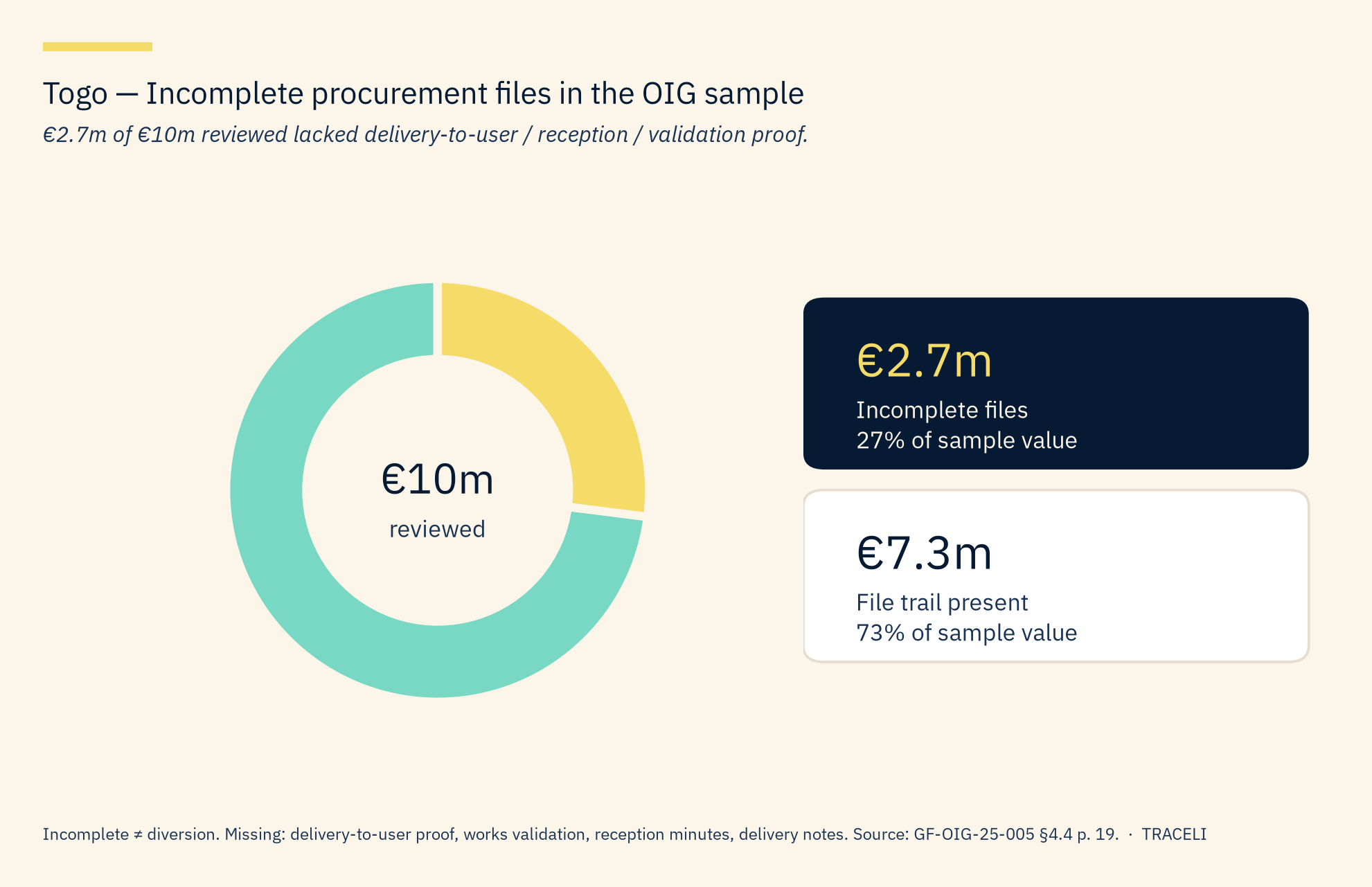
Fiduciary exposure sits in the file. Of €10 million non-health value reviewed, files were incomplete for €2.7 million — missing proof of delivery to final users, final validation of works, reception minutes, delivery notes. Incomplete files are not proof of diversion. They are proof that legitimacy, authorisation, and execution cannot always be demonstrated.
Three reviewed contracts were awarded via restricted negotiation or single sourcing despite rules requiring more competitive tendering for their value — with Global Fund non-objection. OIG notes the exceptions are not in the procedures manual and are not consistently documented; justifying documentation was sometimes missing. Separately, extensions often proceeded without late-execution penalties; 30% of extensions ran up to 18 months, with gaps on who may authorise and how to document.
AMA 3: Secretariat will work with the PR to assess capacity/operations of the PMU procurement team (Cellule des Passation de Marchés within the Unité de Gestion des Projets) and develop an improvement plan. Owner: Head of Grants Management Division. Due: 30 June 2026. Agreed ≠ completed.
Where Trace-li’s assurance path bites
File completeness & competition exceptions
OIG gap (verified): €2.7m of €10m reviewed lacked delivery-to-user / reception / validation proof; three contracts used restricted negotiation or single source despite rules — with GF non-objection; CT scanners €2m unfulfilled as of Oct 2024.
What must be visible before you sign: delivery/reception evidence status on every line; exception trail for non-competitive awards (who authorised, on what basis, with what documenting); fulfilment milestones not left as a post-signature surprise.
Illustrative product UI. Public case ≠ client. Does not claim Trace-li would have rewritten history or prevented the finding.
06 Case 2 — Ghana: the cost components were not what they looked like
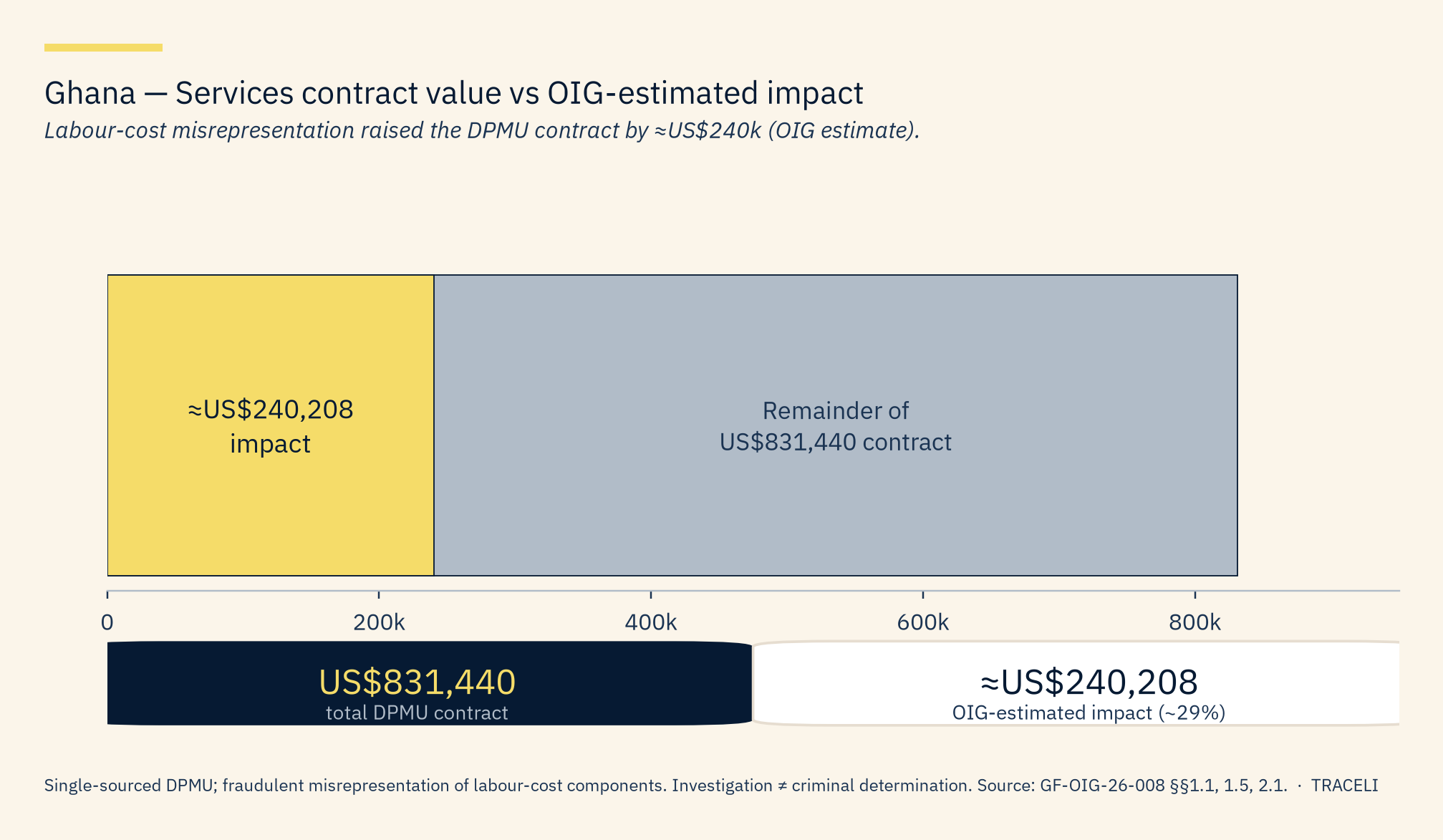
OIG investigated the Global Fund’s award of a services contract valued at US$831,440 to a supplier in Ghana for Data Production, Management and Use (DPMU) project management and technical advice. The DPMU contract was single-sourced, initially US$361,364 (effective 5 October 2021), then raised to US$831,440 in a second phase.
Finding: in proposing for the contract and in negotiations that determined its value, the Supplier engaged in fraudulent practices — specifically, misleading the Global Fund regarding individual labour-cost components (market rate, tax/pension presentation, transportation allowances, health insurance, office costs, and related items). OIG estimates the misrepresentations increased the contract’s value by approximately US$240,208.
Institutional response: Secretariat implemented Agreed Management Action 1 through the Sanctions Panel Procedures Relating to the Code of Conduct for Suppliers; a second AMA addresses lessons for the Procurement Manual on direct contracting. Both marked implemented in the report’s response table.
Where Trace-li’s assurance path bites
Pre-award cost representation
OIG gap (verified): fraudulent misrepresentation of labour-cost components on a single-sourced DPMU contract; OIG-estimated impact ≈US$240,208 on a US$831,440 award.
What must be visible before you sign: the labour-cost basis frozen as a citeable record — component definitions, rates, and what each line actually buys — not a negotiation fog that only becomes clear after the invoice trail.
Illustrative product UI. Public case ≠ client. Does not claim Trace-li would have rewritten history or prevented the finding.
07 Case 3 — Zambia: three bids, one competition story
OIG found Implementing Unit staff and three local suppliers colluded to simulate competition and steer the award to Supplier 1, linked to a Principal Recipient employee. The other two bidders were connected to Supplier 1. The chlorine purchased was above market value: overpay of US$33,092. OIG treats the total contract value of US$78,030 as non-compliant and US$33,092 as potentially recoverable.
Goods were delivered. The scheme was narrow in scope. That does not shrink the lesson: in an emergency, speed without vendor-verification and value-for-money checks can manufacture a competition theatre that looks like a file. Supplier 2 and Supplier 3 shared physical address and contact details; tax certificates carried identical phone numbers and emails; both linked to Supplier 1 and a common shareholder who was a full-time PR employee. Quotations were undated; time of receipt was not documented.
Secretariat measures during the investigation included LFA pre-award review of procurements above US$50,000 (from NFM2) and shifts of health procurement mandate toward ZAMMSA. OIG and Secretariat agreed an AMA to recover funds associated with the collusion, plus AMAs on individuals/suppliers and vendor-verification strengthening. Recommended recoverable ≠ recovered.
Where Trace-li’s assurance path bites
Competition / selection integrity
OIG gap (verified): three interrelated bidders steered award to Supplier 1; contract US$78,030 non-compliant; US$33,092 potentially recoverable overpay.
What must be visible before you sign: independent-bidder checks (shared addresses, contacts, beneficial ownership), timed receipt of quotes, and a disposition trail when “competition” is three letterheads on one economic interest.
Illustrative product UI. Public case ≠ client. Does not claim Trace-li would have rewritten history or prevented the finding.
08 Case 4 — RDT sales: what the award said was not what the strip came from
Implementers procured HIV and malaria RDTs presented as WHO-prequalified. OIG found the Supplier stopped procuring uncut sheets (antigens/antibodies) from the manufacturer named in WHO prequalification documentation — without notifying WHO, implementers, or the PSA as required. That omission/misrepresentation was, more likely than not, knowing or reckless, and misled counterparties into believing contractual QA obligations were met.
Scale during the WHO-prequalified period: implementers in 28 countries reported procuring 34.4 million RDTs from the Supplier, approximate total value US$12.3 million. OIG calculated that approximately 89% (30.8 million) of RDTs supplied in that period could not have contained testing strips from the WHO-stated manufacturer. Approximate value of those potentially non-compliant RDTs: about US$11 million. The Supplier’s volume was ~3.4% of ~1 billion malaria and HIV RDTs procured with Global Fund funds in the period.
Hard qualifications from the report itself: OIG makes no findings on efficacy of the RDTs and no inference on adverse health outcomes; timing and shelf life limited quality conclusions. A second finding: the Supplier more likely than not failed to comply with reasonable OIG requests for records and staff access. Secretariat response: AMA via Sanctions Panel Procedures.
Where Trace-li’s assurance path bites
Product identity / prequalification representation
OIG gap (verified): manufacturing change away from WHO-stated uncut-sheet manufacturer without required notification; ~89% (30.8m) of RDTs in period could not have contained WHO-stated strips; ~US$11m approx. potentially non-compliant value. No efficacy finding.
What must be visible before you sign: the product identity that was actually promised — manufacturer of critical components, notification obligations, and a freeze of what “WHO-prequalified” meant in that award — not only a catalogue name.
Illustrative product UI. Public case ≠ client. Does not claim Trace-li would have rewritten history or prevented the finding.
09 What this means for PRs, SRs, and commercial primes
These files are public. They are not Trace-li clients. They are useful because they make the pre-signature question concrete for anyone who signs Global Fund–funded awards — Principal Recipients, Sub-Recipients, and commercial primes sitting in the same value chain.
Practical questions to take into the next award
- File completeness. If OIG sampled your last thirty non-health contracts, could you produce delivery-to-user proof, reception minutes, and works validation for every euro — or would a €2.7m-shaped hole appear?
- Competition exceptions. When you use restricted negotiation or single source, is the exception in the procedures manual, documented, and owned — or only “non-objected”?
- Cost representation. On fixed-price services, is the labour-cost basis frozen as a citeable record before signature, or reconstructed later from invoices?
- Related parties. Do you check shared addresses, contacts, and beneficial ownership across “competing” bids — especially under emergency timelines?
- Product identity. For health products sold as WHO-prequalified, does the award pack freeze the manufacturer of critical components and notification obligations — or only the brand line?
- AMA honesty. Treat Agreed Management Actions as agreed, not done. Treat recommended recoverable as recommended, not recovered.
The institutional answer is not another dashboard. It is a finished assurance pack: controls mapped, gaps dispositioned, record frozen — before the signature invents a story you cannot reconstruct.
10 Soft close
One completed tender. One desk.
Bring one completed tender. The first packet is free. Make proof a condition of award readiness — before the signature invents a story you cannot reconstruct.
Disclaimer
- Public OIG reports only. These cases are not Trace-li clients and are not presented as client work.
- Audit ≠ criminal. Investigation findings are administrative under Global Fund codes/policies unless a report states otherwise.
- Recommended recoverable ≠ recovered. AMA agreed ≠ completed. Non-objection ≠ clean bill of health.
- Incomplete files ≠ diversion. Approximate / estimated figures are marked as such when the report marks them.
- No prevention claim. Trace-li is framed as the shape of pre-signature assurance — what must be visible before you sign — not as a counterfactual rewrite of these files.
- RDT efficacy. OIG made no efficacy or adverse-outcome findings; this pack does not invent any.
- Distinct cases. GF-OIG-25-005 (Togo) must not be merged with GF-OIG-26-004.
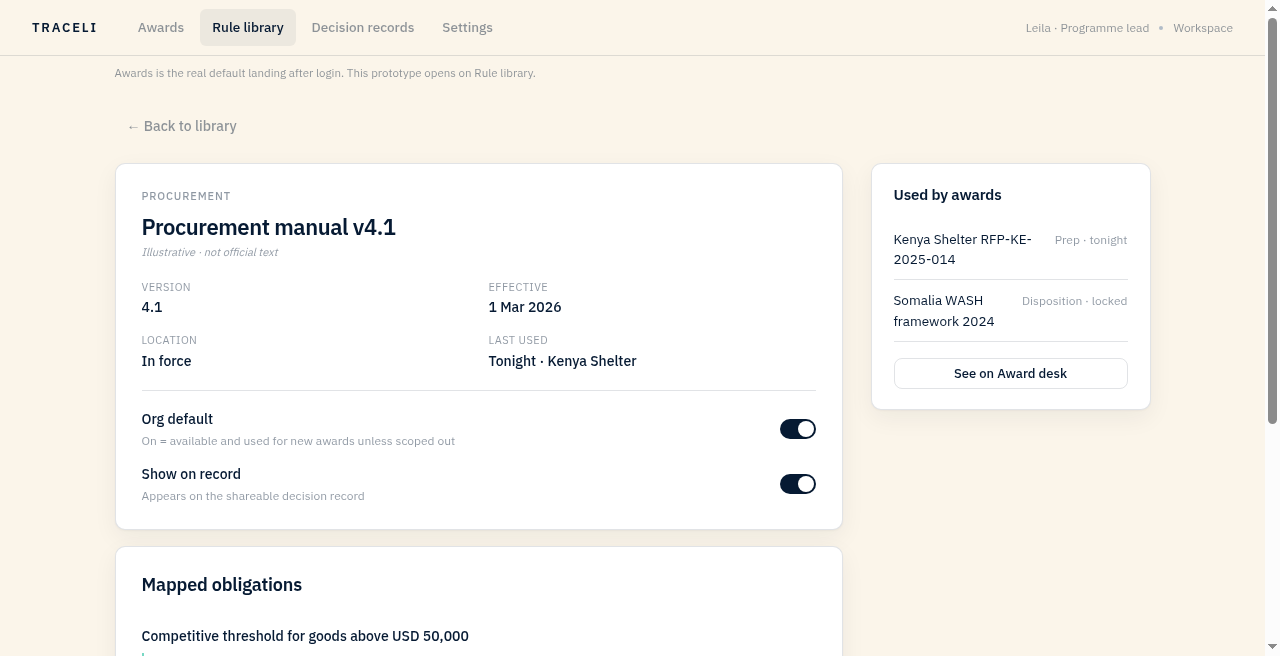
- Product screenshots are illustrative Trace-li wireframes — not evidence drawn from OIG exhibits.
Sources appendix
Full claim → locator table: sources appendix. Primaries read 22 Sep 2026 (Africa/Cairo).
- Global Fund OIG, Audit of Global Fund Grants to the Togolese Republic, GF-OIG-25-005, 4 June 2025 — especially §4.4 pp. 18–19; AMA 3; Exec. Summary opinion. >PDF
- Global Fund OIG, Global Fund Grants in Ghana — Fraudulent Practice in Proposing for Consultancy Services, GF-OIG-26-008, 15 June 2026 — §§1.1, 1.5, 2.1; §3 Response. >PDF
- Global Fund OIG, Global Fund Grants in Zambia (granular chlorine collusion), GF-OIG-23-022, 20 December 2023 — §1.1; Impact / recovery language. >PDF
- Global Fund OIG, Fraudulent Practices in the Sale of Rapid Diagnostic Tests, GF-OIG-26-006, 9 June 2026 — §§1.1–1.4, 2.1; Global Fund Response. >PDF
- OIG reports index: >theglobalfund.org/en/oig/reports/
© Trace-li Research Desk · GF Research 01 · 22 Sep 2026 Africa/Cairo.