01 The signature on the workplan is not the competition file
Country-office colleagues do not need another lecture on fraud. They need to be able to explain, before the workplan or the purchase order moves, why this partner, why this vendor, and where the scored comparison lives. The reconstruction meeting is expensive. The finished, citeable record before signature is the thing that makes that meeting boring.
This note reads three public OAIS files from 2025: the investigation annex behind the annual report, and the Sudan country-office audit. One file is an implementing partner that falsified payroll and bought from conflicted vendors. One is a vendor with undisclosed ties to its competitors. One is a named office, operating in an armed conflict, where non-competitive partner selection missed a Regional Director approval and the solicitation documents did not carry evaluation criteria. Together they are a map of what has to be visible before you sign — not a tour of Trace-li features.
02 Method & claim hygiene
pdftotext, and kept only figures that appear in those reports.
Locators are in the sources appendix. Charts were rebuilt from that table.
What we did not claim. That these offices or partners are Trace-li clients. That Trace-li would have prevented the outcomes. That an investigation is a criminal verdict. That a quantified loss was recovered. That a debarment, a UNPP flag, or a referral to the Vendor Review Committee is the same thing as a completed sanction. That an agreed recommendation is done. That a missing purchase order, an incomplete receiving report, or an overdue micro-assessment is diversion. That Annex 4’s region band can be turned into a country or a person’s name. That the dignity-kit contract split in the annual report can be pinned to a named office — it cannot, on the public text we read.
Cases locked after verification: Annex 4 entry 13 (East and Southern Africa implementing partner, US$1,441,593); Annex 4 entry 21 (Arab States vendor, US$140,177.43); IA/2025-29 (Sudan country office, 24 December 2025, rating Partially Satisfactory with Major Improvement Needed). The systemic frame is DP/FPA/2026/6, the OAIS annual report for 2025 (issued 6 April 2026; the PDF’s own metadata is 1 May 2026). DRC IA/2024-24 was screened and left out. Annex 4 entry 11 was left out so its loss figure would not leak into this note.
A companion note on Global Fund OIG files is The award was signed. The proof was not ready. The published case card for IA/2025-29 is founder Freeze #3, a synthetic rehearsal with 4 of 27 pack keys read from the packet (1 negative, 3 stated absent). Fixture case cards, awaiting a founder freeze, are Annex 4 entry 13 and Annex 4 entry 21. The index is /cases.
03 The pattern across three files
Different instruments — an investigation summary, another investigation summary, a country-office audit — and one recurring structure. The competition path, the related-party question, the approval authority, the solicitation file, and the supporting documents do not all fail in the same place. The matrix is a synthesis. It is not a score, and it is not an OAIS rating.
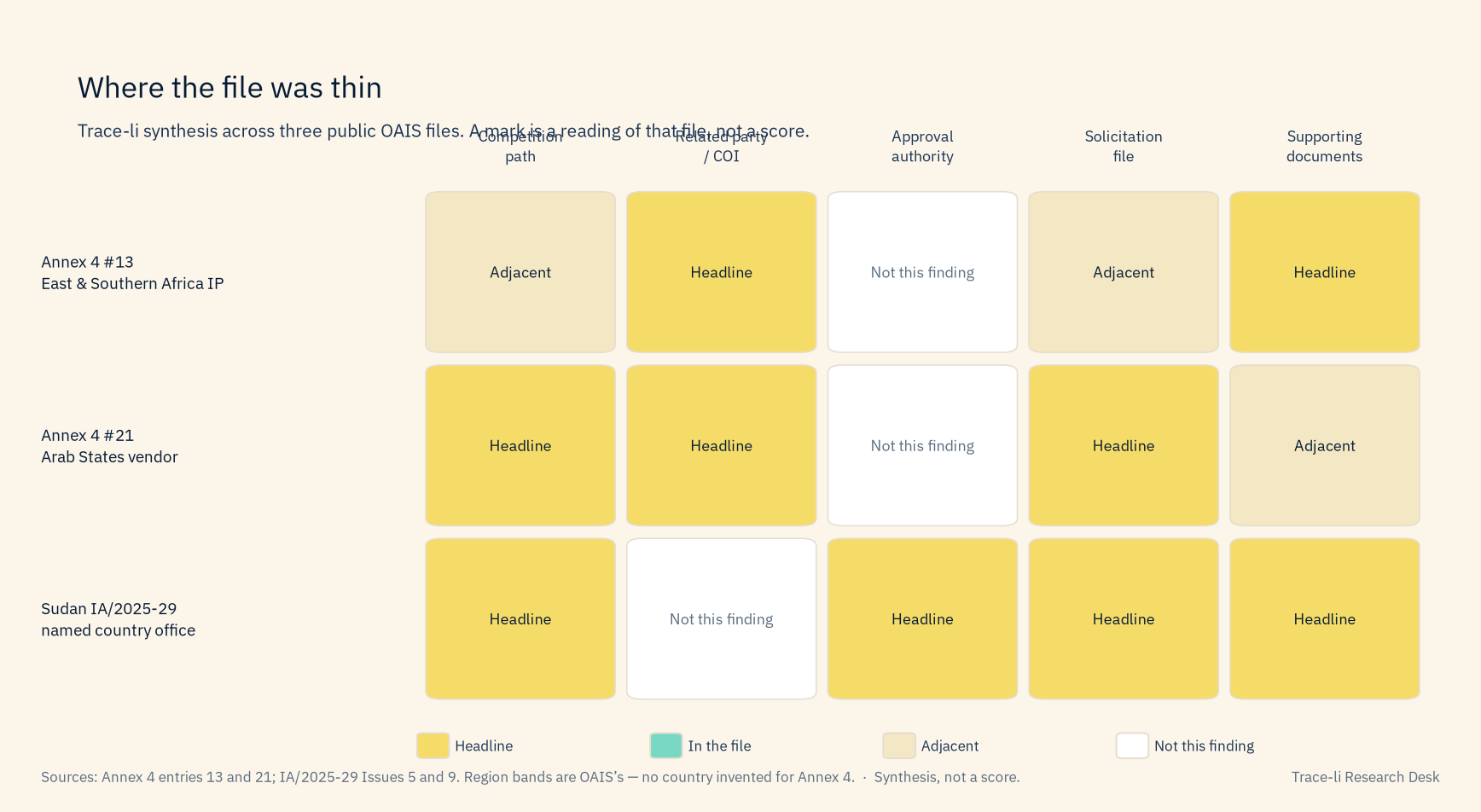
The 2025 audit reports, taken together, already describe the pattern at office scale. Ineffective management and oversight of implementing partners was the most frequent challenge, affecting 21 country offices, including non-competitive selection of non-governmental partners and failure to conduct timely assurance. Noncompliance with procurement procedures was noted in 14 countries; the summary says those offices frequently failed to develop comprehensive procurement plans or to establish long-term agreements for recurring purchases. A separate count — do not add it to the 21 or the 14 — is 14 country offices with weaknesses in programme supplies management.
Later in the same report, OAIS lists what compliance with procurement procedures means in practice: comprehensive plans, competitive solicitation, policy-mandated receipt and inspection reports, submission of qualifying cases to contracts review committees, and long-term agreements. That list is the control surface auditors asked offices to meet. It is not a finding that each of the 14 countries failed every item on it.
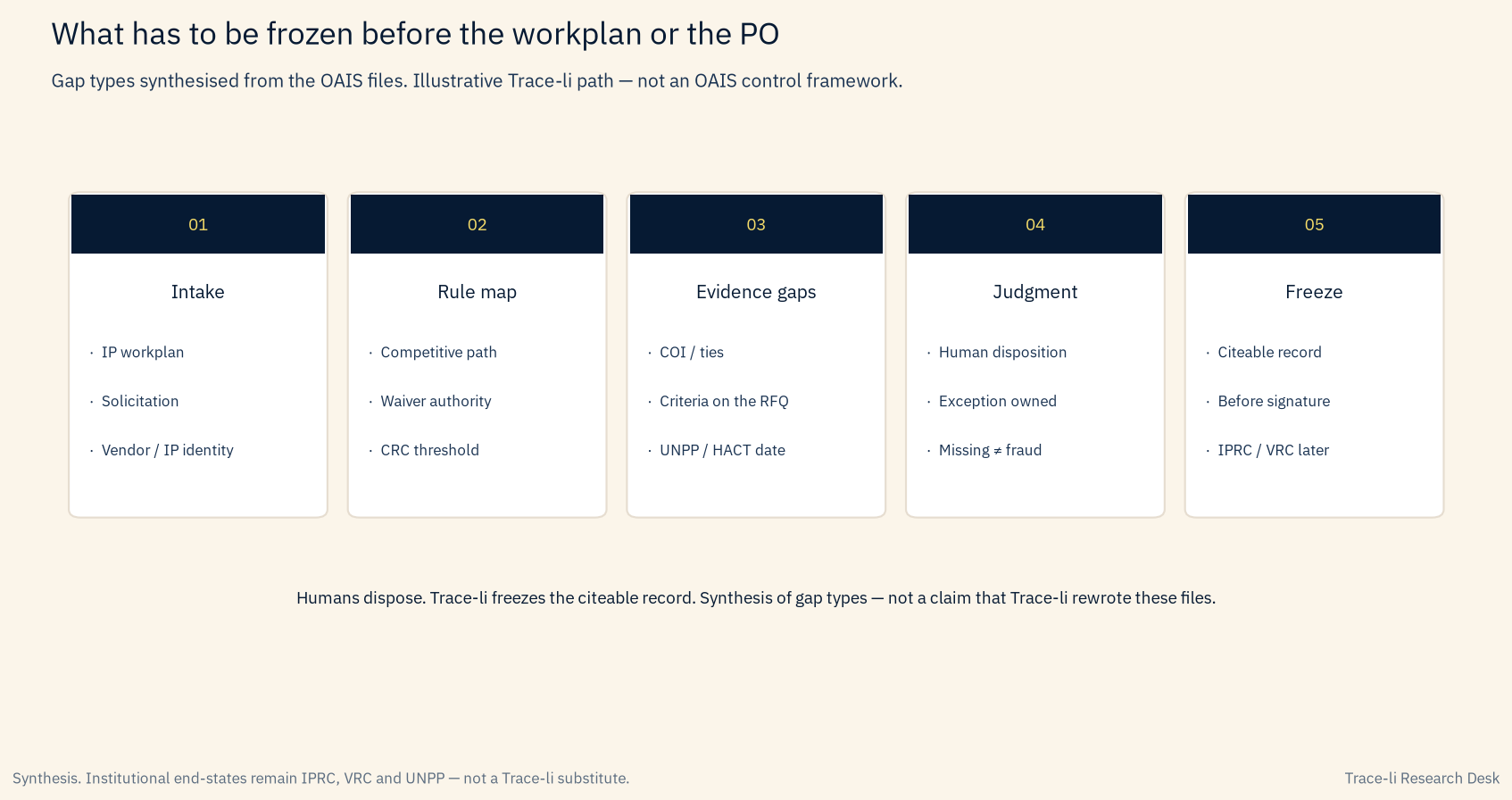
On the investigation side, of 49 cases closed after a full investigation in 2025, 33 were substantiated in full or in part and two third-party dossiers were endorsed. Of that set, 21 cases (60 per cent) concerned fraud and financial irregularities: 12 proscribed practices, five implementing-partner fraud, three supplier fraud, and one gross negligence. Twelve of the financial cases had an estimated loss. The aggregate OAIS states in the body is US$2,931,265. The footnote, and the Annex 4 total line, print US$2,931,264.81. Management is pursuing recovery. Pursuing is not the same sentence as recovered.
04 Value chain: what Trace-li’s path is shaped to hold
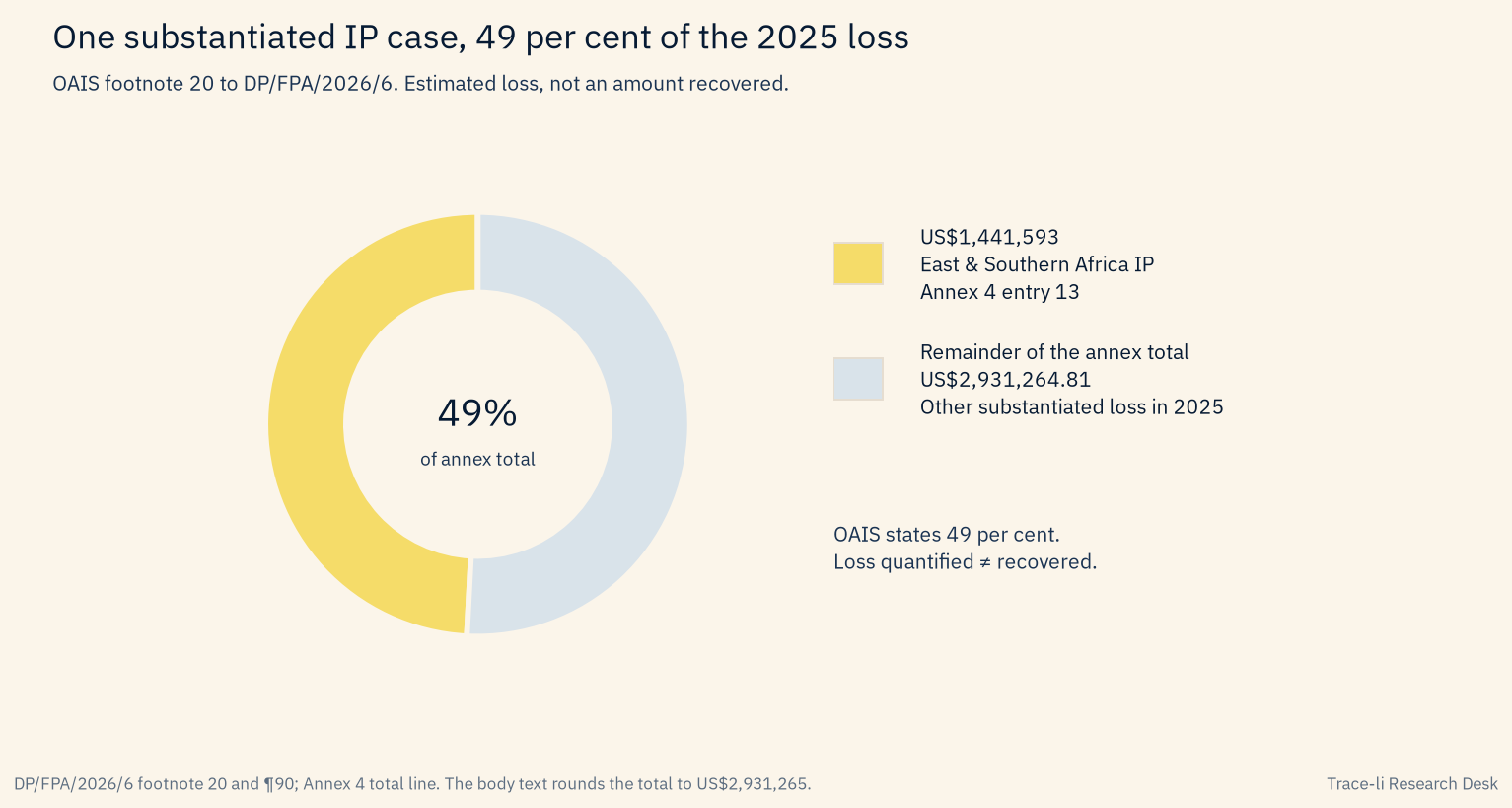
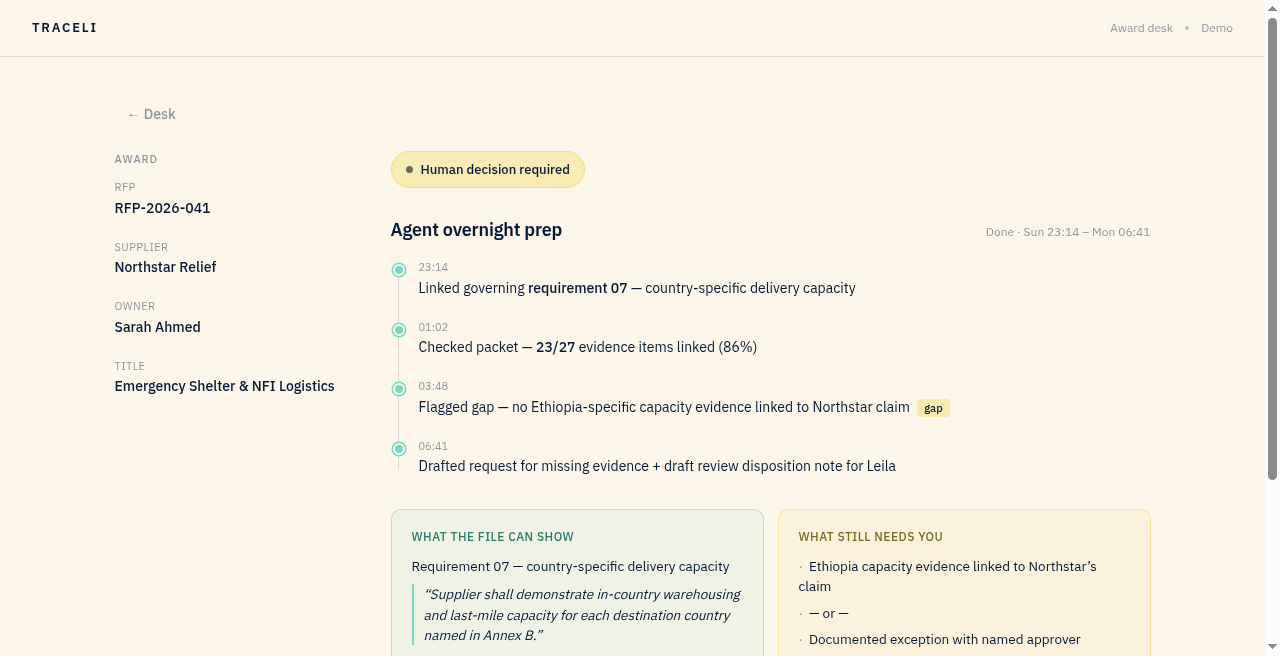
We are not going to say Trace-li would have prevented these outcomes. The useful sentence is narrower. This is what must be visible and dispositioned before signature — the competitive path or the documented waiver, the approval authority the threshold actually requires, the conflict-of-interest and related-party fields, the evaluation criteria on the solicitation itself, and a citeable record of what a human decided to do about each gap.
Institutional end-states stay where OAIS put them. The Implementing Partner Review Committee reviews a partner after an investigation report. The Vendor Review Committee recommends a vendor-sanctions decision to the Chief Procurement Official. A UNPP flag is a portal fact. Trace-li does not replace those bodies. It is shaped to freeze the proof those bodies, and the representative who signs, would otherwise have to reconstruct. Humans dispose. Trace-li freezes the record.
05 Case 1 — The partner file that could not support the payroll
The summary is short because Annex 4 is a closure table, not the full investigation report. What it does say is specific. A UNFPA implementing partner falsified payroll and timesheets, procured the services of vendors in violation of conflict-of-interest procurement rules, contracted with vendors which engaged in fraudulent practices, and submitted fraudulent reports that misreported activities.
OAIS submitted the investigation report to the Legal Office and recommended referral to the Implementing Partner Review Committee and the Vendor Review Committee. The partner has been debarred. The IPRC raised a flag against the partner on the United Nations Partner Portal. Efforts to recover the loss are ongoing. The vendor list was referred to the VRC, and that review is ongoing.
Read the verbs carefully. Substantiated is an administrative investigative result. Debarred and flagged are actions the annex states have happened. Recovery ongoing is not recovered. VRC review ongoing is not a vendor-sanctions decision. Nothing in the public summary is a criminal verdict.
Where the assurance path bites
IP eligibility, conflicted vendors, supporting documents
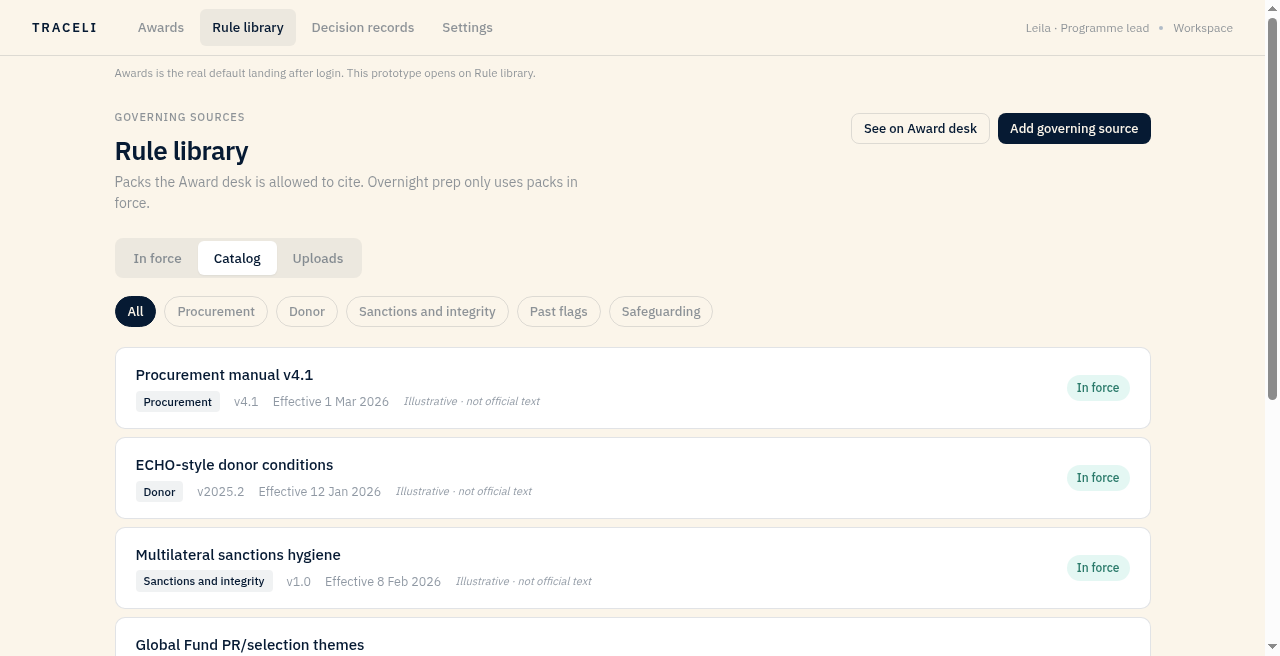
OAIS gap (verified): falsified payroll and timesheets; vendors engaged in violation of conflict-of-interest rules; fraudulent activity reports. Loss US$1,441,593. Recovery ongoing. UNPP flag stated.
What must be visible before you sign the workplan: the partner’s eligibility and UNPP status, conflict-of-interest declarations on the IP–vendor link, and the supporting documents the payment will later depend on — not a narrative that only becomes testable after FACE.
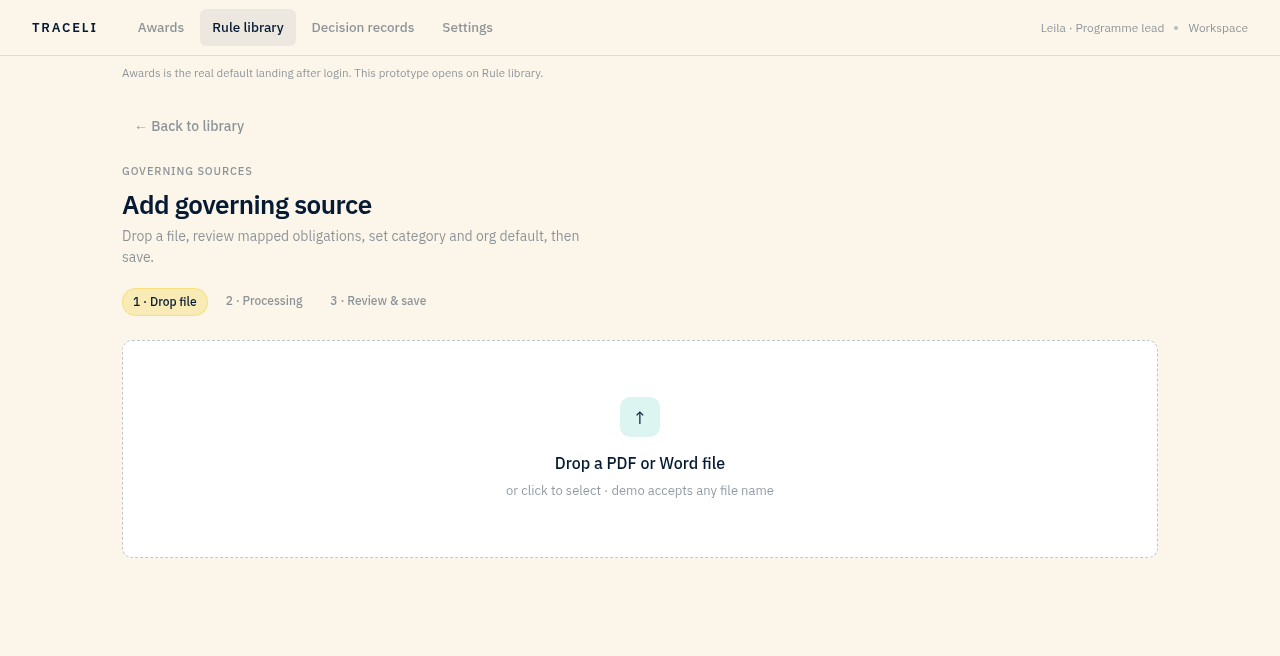
Illustrative product UI. Public case is not a client. Does not claim Trace-li would have prevented the finding.
06 Case 2 — Competing vendors that were not separate
A UNFPA vendor was involved in procurements that were fraudulent and violated several elements of UNFPA’s procurement regulations. The vendor also had undisclosed ties with competing vendors in those procurements. OAIS referred the matter to the Vendor Review Committee. The annex says the VRC review is ongoing.
This is the competition-theatre problem in a single paragraph. A solicitation can look like a comparison of independent bidders while the economic interest behind the letterheads is shared and undisclosed. The public summary does not print addresses, ownership percentages, or a country. It does print the tie, the loss, and the fact that the sanctions review had not finished when the annex was issued.
The annual report’s other high-risk procurement paragraph should stay in its own box. Paragraph 44(a) describes one unnamed country office that split contracts for dignity kits totalling US$1.38 million to bypass higher-level Contracts Review Committee review. The same paragraph records a funding gap in that office: US$2.0 million in unfunded salary costs, US$1.0 million in unbudgeted fixed costs, and an emergency US$3.2 million core allocation from headquarters. The office is anonymized. This note does not assign paragraph 44(a) to Sudan, to the Arab States vendor, or to any other named file.
Where the assurance path bites
Related parties on a competitive solicitation
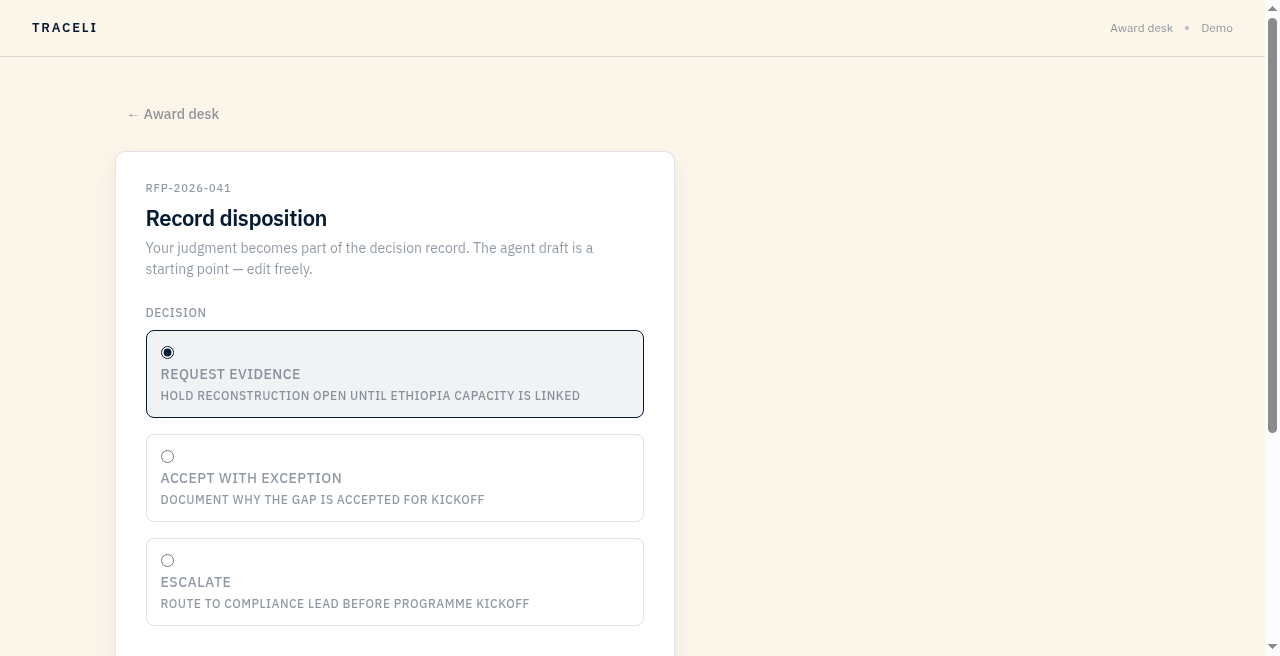
OAIS gap (verified): fraudulent procurements and undisclosed ties with competing vendors. Loss US$140,177.43. VRC review ongoing.
What must be visible before you sign: beneficial-ownership and related-party fields across the bidders actually invited, and a solicitation file that can show the comparison was among separate vendors. The dignity-kit split in ¶44(a) is a different control — contract-splitting against the contracts-review threshold — and it stays an annual-report cite until a named audit paragraph is locked.
Illustrative product UI. Public case is not a client. Does not claim Trace-li would have prevented the finding.
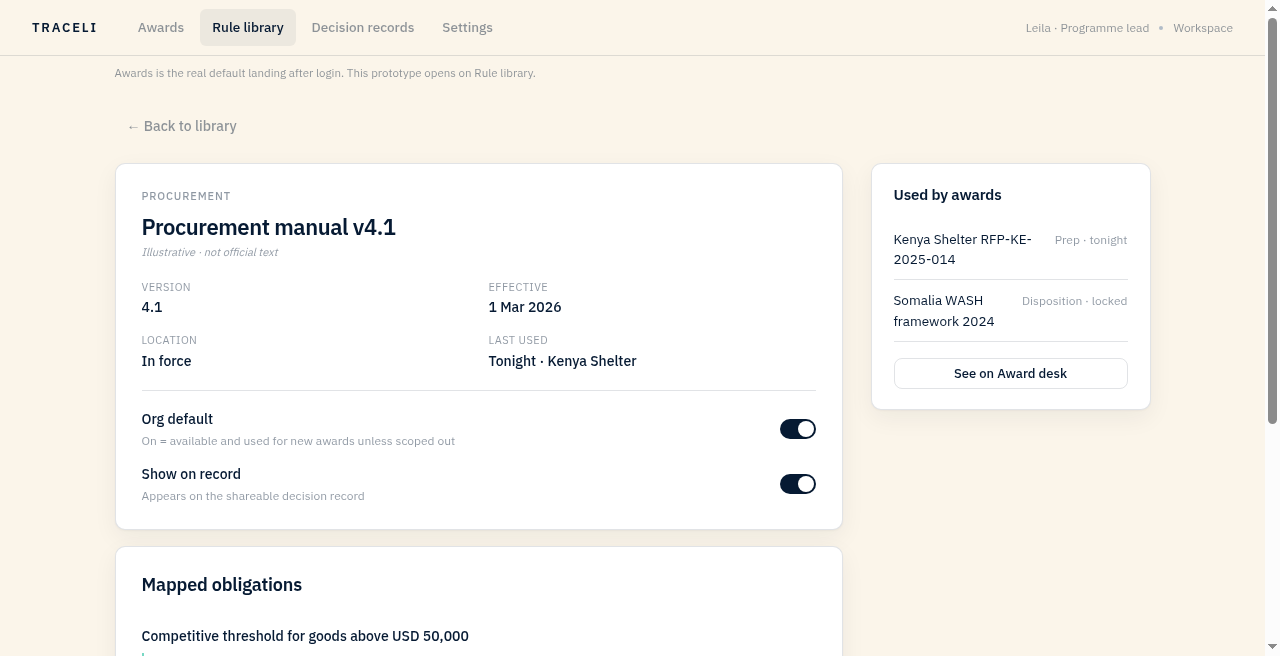
07 Case 3 — Sudan: the approval, the criteria, and the receiving report
Sudan is the named office in this note because the pre-award gaps are written down as procedure, not as a region-banded loss. The office was working inside an armed conflict. OAIS records that context and still rates implementing-partner management as major improvement needed, and procurement as some improvement needed.
On partner selection, policy as the audit states it allows a non-competitive path in exceptional circumstances, with documented justification and approval from the head of office — or from the Regional Director when cumulative workplan amounts for the programme cycle are expected to exceed US$0.5 million. The office engaged three NGO partners non-competitively. The Representative approved. The audit team viewed the choice as justified in the humanitarian context. Regional Director approval was still required, because each partner’s cumulative workplan exceeded the threshold. Recommendation 5 is high priority. Management agreed. The estimated completion date is December 2026. Agreed is not done.
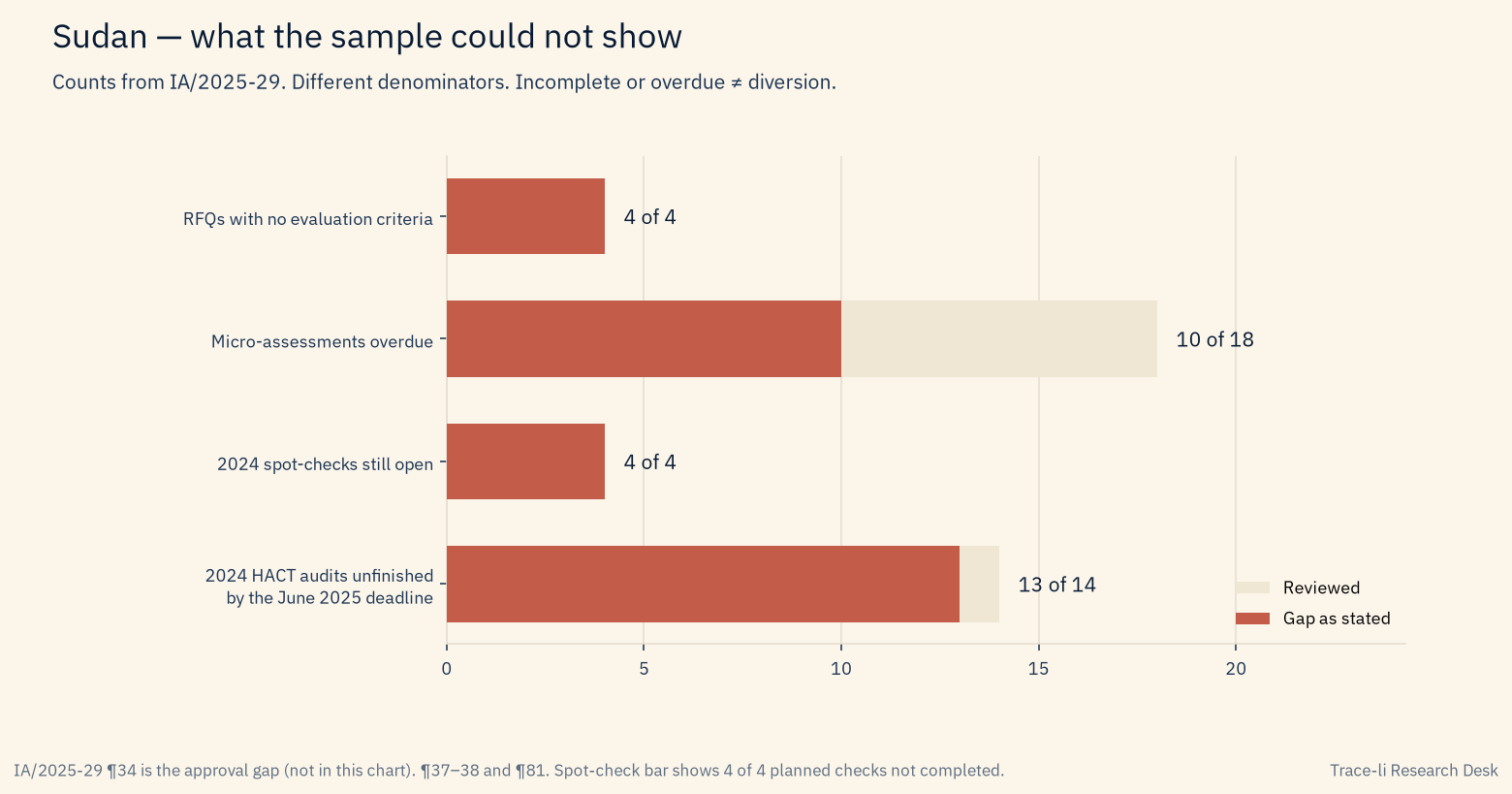
Assurance on those partners was late. Ten of 18 required micro-assessments were overdue, six of them by more than a year, and the office did not apply the high-risk rating policy requires until a micro-assessment is completed. None of four spot-checks planned for 2024 had been completed at fieldwork. Only one of 14 HACT audits planned for 2024 was done by the June 2025 deadline.
The procurement sample is the competition file in miniature. In three of ten transactions there was no approved purchase order: visibility items at US$55,800, Sudanese Toub and Jalayia at US$171,000, and printed GBV guidelines at US$12,137. Security services of US$48,420 were procured between May and December 2023 without valid contracts — dates the audit reports even though they sit before the expense period in the executive summary. A warehouse contractor was engaged without an approved purchase order for US$21,420; a note-to-file cited a monthly rate of US$6,000 against invoiced charges the audit describes as US$7,140 a month, and the discrepancy was not documented.
Two awards leaned on another UN organization’s long-term agreement without a rate reconciliation the file could show. Third-party monitoring at US$179,300 was charged on aggregate prices against an LTA that itemized labour and materials. An interactive voice-response hotline at US$78,373 was charged on an aggregate fee that included labour, against an LTA that did not include labour fees.
All four requests for quotation in the sample omitted evaluation criteria: the three contract-modality gaps above, plus venue and stationery at US$18,500. Evaluators listed criteria in the evaluation reports and recorded no individual scores. Two of ten transactions had no policy-mandated receiving and inspection report available (the guidelines at US$12,137 and the hotline at US$78,373); a noncompliant template was used instead. Three further RIRs — visibility items, Toub and Jalayia, and the security services — did not certify acceptance or rejection. Recommendation 9 is medium priority. Management agreed, with an estimated completion of March 2026.
Programme supplies show the same “signed, but the line is missing” shape. An implementing partner received donated supplies of US$13.0 million. The signed workplans did not include the non-cash transfers: type, estimated volume, value, or intended use. They carried cash activities such as transport. Separately, the audit records supplies of US$550,000 expired at Port Sudan warehouses, and loss of access to supplies valued at US$1.2 million in a Khartoum warehouse, with an insurance claim from June 2024 still unsettled at July 2025. Demurrage from customs delays was US$248,412. None of those sentences is a diversion finding.
The annual report’s paragraph 44(b) describes an unnamed office with the same two inventory amounts — US$1.2 million inaccessible, insurance claim from June 2024 unsettled as of December 2025, and US$550,000 expired. The Sudan audit names the warehouses. This note does not declare that OAIS’s anonymized paragraph “is” Sudan. It records that the public Sudan audit carries the same figures, and that paragraph 44(a)’s dignity-kit split remains unnamed.
Where the assurance path bites
Waiver authority, criteria on the RFQ, receiving file
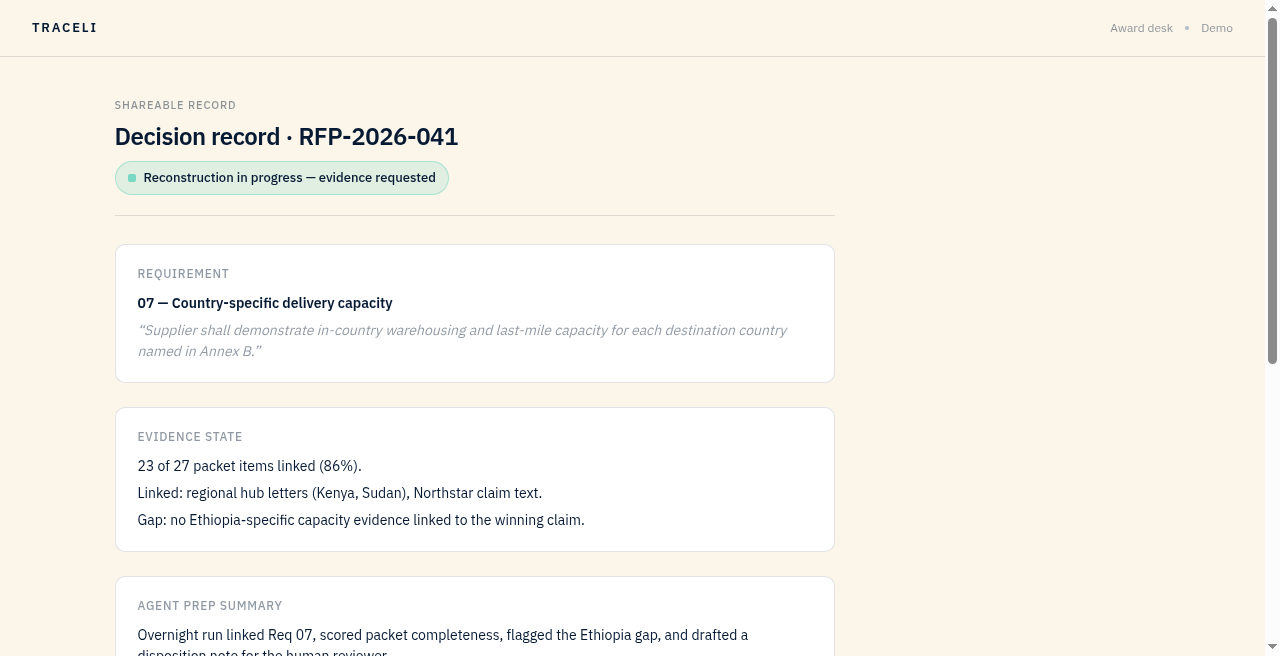
OAIS gap (verified): three NGO partners above the US$0.5 million cumulative-workplan threshold without Regional Director approval; four of four RFQs without evaluation criteria or individual scores; purchase orders and RIRs missing or incomplete in the sample; US$13.0 million of donated supplies absent from the workplan’s non-cash lines.
What must be visible before you sign: the approval the threshold actually names, the scoring mechanism printed in the solicitation, a purchase order before delivery, and commodity lines on the workplan when the transfer is not cash. An incomplete receiving report is a file gap. It is not, on this audit, proof of diversion.
Illustrative product UI. Public case is not a client. Does not claim Trace-li would have prevented the finding.
08 What this means for representatives, operations, and the committees
These files are public. They are not Trace-li clients. They are useful to people who sign UNFPA workplans and purchase orders, and to the committees that see a file only after OAIS has written a report.
Practical questions before the next signature
- Competition path. If the partner was not competed, is the waiver on the template the policy names, and is the approver the one the cumulative workplan actually requires?
- Related parties. Do the bidders’ ties, ownership, and shared contacts sit in the solicitation file before award — or only in an investigation summary afterwards?
- Criteria. Are evaluation criteria in the request for quotation that the vendor received, with individual scores, or only as a list reconstructed in an evaluation note?
- Committee threshold. Would a dignity-kit buy of the US$1.38 million kind in ¶44(a) have reached the contracts review committee, or was the contract split around it? Cite that figure from the annual report until a named audit locks it.
- Workplan contents. If the partner will receive commodities, are type, quantity, value, and intended use on the signed workplan, or only the cash lines for transport?
- Assurance timing. Is the micro-assessment date current, and is an overdue partner treated as high risk until it is? Overdue is not the same sentence as “this partner failed.”
- After the fact. Debarment, a UNPP flag, and a VRC referral are what the institution does once a report exists. They do not restore a competition file that was never frozen.
The same standard of honesty applies to status. Sudan’s recommendations are agreed, with dates in 2026. Annex 4’s recovery efforts and VRC reviews are ongoing. The annual report says management is pursuing every avenue of loss recovery. None of those sentences is permission to write “closed” or “recovered.”
09 Soft close
One workplan. One frozen file.
Bring one implementing-partner workplan or one purchase order that is about to be signed. The question is whether the competition path, the approval, and the supporting documents can be cited before the signature — not whether an investigation will be able to reconstruct them later.
Disclaimer
- Public OAIS reports only. These cases are not Trace-li clients and are not presented as client work.
- Investigation ≠ criminal. “Substantiated” in Annex 4 is an administrative result unless a report says otherwise. The Sudan file is an audit opinion.
- Quantified loss ≠ recovered. Referral, debarment, and a UNPP flag are reported only where Annex 4 states them. VRC review ongoing and recommendations agreed are not completed outcomes.
- Incomplete file ≠ diversion. A missing purchase order, an incomplete receiving report, an overdue micro-assessment, and an anonymized contract split are file and control findings. They are not proof of theft.
- No prevention claim. Trace-li is framed as the shape of pre-signature assurance. It does not rewrite these files.
- Annex 4 is region-banded. No country and no personal name has been added to entries 13 or 21.
- Paragraph 44(a) is cited from the annual report only. The dignity-kit split is not assigned to a named country office.
- Screens are illustrative Trace-li desk UI in a Global Fund pack shape. They are not a live UNFPA desk run and not OAIS exhibits.
Sources appendix
Full claim → locator table: sources appendix. Primaries read 24 Sep 2026 (Africa/Cairo).
- UNFPA OAIS, Report on internal audit and investigation activities in 2025, DP/FPA/2026/6, 6 April 2026 (PDF metadata 1 May 2026) — summary bullets; ¶42 area; ¶44(a)–(b); ¶87; ¶89(a); ¶90 and footnote 20. PDF
- OAIS, Annex 4, Summary of investigation and closure reports issued in 2025, entries 13 and 21, footnotes 7 and 8, closing total. PDF
- OAIS, Audit of the UNFPA Country Office in the Republic of the Sudan, IA/2025-29, 24 December 2025 — ¶3, ¶5–6, ¶33–34, ¶37–38, ¶51–52, ¶55–56, ¶61–62, ¶78–83; Recommendations 5 and 9. PDF
- Companion note: Global Fund OIG research. Published case card: IA/2025-29. Fixture case cards: Annex 4 entry 13, entry 21.
© Trace-li Research Desk · UNFPA research · 24 Sep 2026 Africa/Cairo.